


Page 94 - Basic Principles of Textile Coloration
P. 94
COTTON PROCESSING 83

nature is not known. For the production of high quality white fabrics, and for
those that will be dyed in pale or medium, bright shades, bleaching is essential. It
is not necessary for dull or dark shades provided the fabric is already of adequate
and uniform absorbency. The types of chemicals used include hypochlorites,
chlorites and peroxides, hydrogen peroxide being by far the chemical of choice.

   The traditional use of bleaching powder (calcium hypochlorite, Ca(OCl)2) for
cotton bleaching is now almost obsolete. Bleaching cotton with alkaline solutions
of sodium hypochlorite (NaOCl) was once common. Hydrogen peroxide (H2O2)
has taken its place. A successful continuous method of bleaching with
hypochlorite was never developed. Even in a batch process, careful control of the
temperature and a pH above 10 were essential to avoid over-oxidation of the
cellulose. In hot, neutral hypochlorite solution, oxycellulose formation is rapid. In
addition, effective alkali boiling was essential as starch residues and proteins both
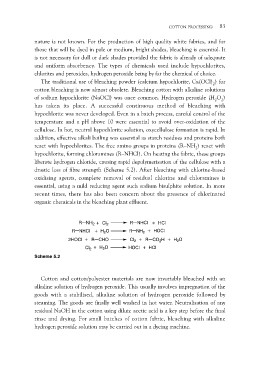
react with hypochlorites. The free amino groups in proteins (R–NH2) react with
hypochlorite, forming chloramines (R–NHCl). On heating the fabric, these groups
liberate hydrogen chloride, causing rapid depolymerisation of the cellulose with a
drastic loss of fibre strength (Scheme 5.2). After bleaching with chlorine-based
oxidising agents, complete removal of residual chlorine and chloramines is
essential, using a mild reducing agent such sodium bisulphite solution. In more
recent times, there has also been concern about the presence of chlorinated
organic chemicals in the bleaching plant effluent.

                  R NH2 + Cl2     R NHCl + HCl
              R NHCl + H2O        R NH2 + HOCl
            2HOCl + R CHO         Cl2 + R CO2H + H2O
                                  HOCl + HCl
                       Cl2 + H2O

Scheme 5.2

   Cotton and cotton/polyester materials are now invariably bleached with an
alkaline solution of hydrogen peroxide. This usually involves impregnation of the
goods with a stabilised, alkaline solution of hydrogen peroxide followed by
steaming. The goods are finally well washed in hot water. Neutralisation of any
residual NaOH in the cotton using dilute acetic acid is a key step before the final
rinse and drying. For small batches of cotton fabric, bleaching with alkaline
hydrogen peroxide solution may be carried out in a dyeing machine.

