


Page 110 - Elementary_Linear_Algebra_with_Applications_Anton__9_edition
P. 110
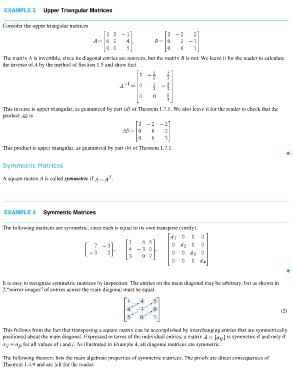
EXAMPLE 3 Upper Triangular Matrices
Consider the upper triangular matrices

The matrix A is invertible, since its diagonal entries are nonzero, but the matrix B is not. We leave it for the reader to calculate
the inverse of A by the method of Section 1.5 and show that

This inverse is upper triangular, as guaranteed by part (d) of Theorem 1.7.1. We also leave it for the reader to check that the
product is

This product is upper triangular, as guaranteed by part (b) of Theorem 1.7.1.

Symmetric Matrices                        .

A square matrix A is called symmetric if

EXAMPLE 4 Symmetric Matrices
The following matrices are symmetric, since each is equal to its own transpose (verify).

It is easy to recognize symmetric matrices by inspection: The entries on the main diagonal may be arbitrary, but as shown in
2,“mirror images” of entries across the main diagonal must be equal.

                                                                                                                                 (2)

This follows from the fact that transposing a square matrix can be accomplished by interchanging entries that are symmetrically

positioned about the main diagonal. Expressed in terms of the individual entries, a matrix    is symmetric if and only if

for all values of i and j. As illustrated in Example 4, all diagonal matrices are symmetric.

The following theorem lists the main algebraic properties of symmetric matrices. The proofs are direct consequences of
Theorem 1.4.9 and are left for the reader.

