


Page 111 - Elementary_Linear_Algebra_with_Applications_Anton__9_edition
P. 111
THEOREM 1.7.2
  If A and B are symmetric matrices with the same size, and if k is any scalar, then:
     (a) is symmetric.
     (b) and are symmetric.
     (c) is symmetric.

Remark It is not true, in general, that the product of symmetric matrices is symmetric. To see why this is so, let A and B be
symmetric matrices with the same size. Then from part (d) of Theorem 1.4.9 and the symmetry, we have

Since and are not usually equal, it follows that will not usually be symmetric. However, in the special case where

, the product will be symmetric. If A and B are matrices such that                     , then we say that A and B commute. In

summary: The product of two symmetric matrices is symmetric if and only if the matrices commute.

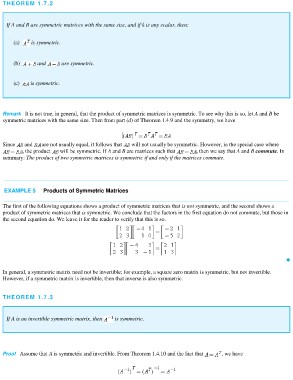
EXAMPLE 5 Products of Symmetric Matrices

The first of the following equations shows a product of symmetric matrices that is not symmetric, and the second shows a
product of symmetric matrices that is symmetric. We conclude that the factors in the first equation do not commute, but those in
the second equation do. We leave it for the reader to verify that this is so.

In general, a symmetric matrix need not be invertible; for example, a square zero matrix is symmetric, but not invertible.
However, if a symmetric matrix is invertible, then that inverse is also symmetric.

THEOREM 1.7.3

  If A is an invertible symmetric matrix, then is symmetric.

Proof Assume that A is symmetric and invertible. From Theorem 1.4.10 and the fact that  , we have

