


Page 136 - Elementary_Linear_Algebra_with_Applications_Anton__9_edition
P. 136
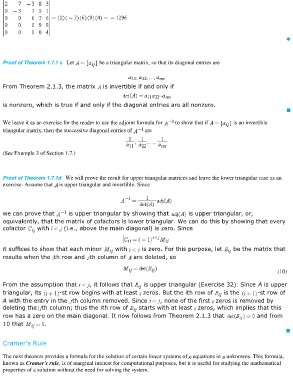
Proof of Theorem 1.7.1 c Let     be a triangular matrix, so that its diagonal entries are

From Theorem 2.1.3, the matrix is invertible if and only if

is nonzero, which is true if and only if the diagonal entries are all nonzero.

We leave it as an exercise for the reader to use the adjoint formula for  to show that if  is an invertible
triangular matrix, then the successive diagonal entries of are

(See Example 3 of Section 1.7.)

Proof of Theorem 1.7.1d We will prove the result for upper triangular matrices and leave the lower triangular case as an
exercise. Assume that is upper triangular and invertible. Since

we can prove that is upper triangular by showing that                     is upper triangular, or,

equivalently, that the matrix of cofactors is lower triangular. We can do this by showing that every

cofactor with (i.e., above the main diagonal) is zero. Since

it suffices to show that each minor with  is zero. For this purpose, let                   be the matrix that

results when the th row and th column of are deleted, so

                                                                                                             (10)

From the assumption that , it follows that is upper triangular (Exercise 32). Since A is upper

triangular, its     -st row begins with at least zeros. But the ith row of is the                   -st row of

A with the entry in the th column removed. Since , none of the first zeros is removed by
deleting the th column; thus the ith row of starts with at least zeros, which implies that this

row has a zero on the main diagonal. It now follows from Theorem 2.1.3 that                         and from

10 that          .

Cramer's Rule

The next theorem provides a formula for the solution of certain linear systems of equations in unknowns. This formula,
known as Cramer's rule, is of marginal interest for computational purposes, but it is useful for studying the mathematical
properties of a solution without the need for solving the system.

