


Page 18 - Elementary_Linear_Algebra_with_Applications_Anton__9_edition
P. 18
1.2                   In this section we shall develop a systematic procedure for solving systems of
                      linear equations. The procedure is based on the idea of reducing the augmented
GAUSSIAN ELIMINATION  matrix of a system to another augmented matrix that is simple enough that the
                      solution of the system can be found by inspection.

Echelon Forms

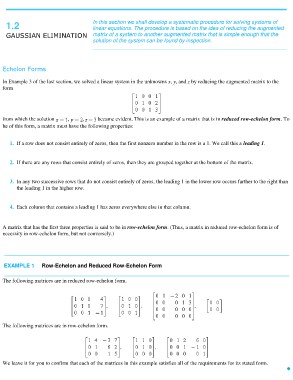
In Example 3 of the last section, we solved a linear system in the unknowns x, y, and z by reducing the augmented matrix to the
form

from which the solution , , became evident. This is an example of a matrix that is in reduced row-echelon form. To
be of this form, a matrix must have the following properties:

    1. If a row does not consist entirely of zeros, then the first nonzero number in the row is a 1. We call this a leading 1.

    2. If there are any rows that consist entirely of zeros, then they are grouped together at the bottom of the matrix.

    3. In any two successive rows that do not consist entirely of zeros, the leading 1 in the lower row occurs farther to the right than
       the leading 1 in the higher row.

    4. Each column that contains a leading 1 has zeros everywhere else in that column.

A matrix that has the first three properties is said to be in row-echelon form. (Thus, a matrix in reduced row-echelon form is of
necessity in row-echelon form, but not conversely.)

EXAMPLE 1 Row-Echelon and Reduced Row-Echelon Form
The following matrices are in reduced row-echelon form.

The following matrices are in row-echelon form.
We leave it for you to confirm that each of the matrices in this example satisfies all of the requirements for its stated form.

