


Page 23 - Elementary_Linear_Algebra_with_Applications_Anton__9_edition
P. 23
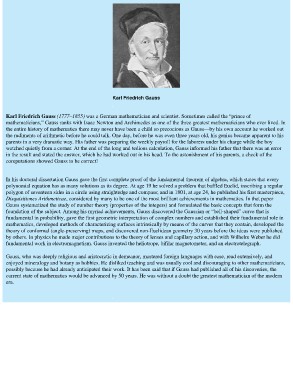
Karl Friedrich Gauss

Karl Friedrich Gauss (1777–1855) was a German mathematician and scientist. Sometimes called the “prince of
mathematicians,” Gauss ranks with Isaac Newton and Archimedes as one of the three greatest mathematicians who ever lived. In
the entire history of mathematics there may never have been a child so precocious as Gauss—by his own account he worked out
the rudiments of arithmetic before he could talk. One day, before he was even three years old, his genius became apparent to his
parents in a very dramatic way. His father was preparing the weekly payroll for the laborers under his charge while the boy
watched quietly from a corner. At the end of the long and tedious calculation, Gauss informed his father that there was an error
in the result and stated the answer, which he had worked out in his head. To the astonishment of his parents, a check of the
computations showed Gauss to be correct!

In his doctoral dissertation Gauss gave the first complete proof of the fundamental theorem of algebra, which states that every
polynomial equation has as many solutions as its degree. At age 19 he solved a problem that baffled Euclid, inscribing a regular
polygon of seventeen sides in a circle using straightedge and compass; and in 1801, at age 24, he published his first masterpiece,
Disquisitiones Arithmeticae, considered by many to be one of the most brilliant achievements in mathematics. In that paper
Gauss systematized the study of number theory (properties of the integers) and formulated the basic concepts that form the
foundation of the subject. Among his myriad achievements, Gauss discovered the Gaussian or “bell-shaped” curve that is
fundamental in probability, gave the first geometric interpretation of complex numbers and established their fundamental role in
mathematics, developed methods of characterizing surfaces intrinsically by means of the curves that they contain, developed the
theory of conformal (angle-preserving) maps, and discovered non-Euclidean geometry 30 years before the ideas were published
by others. In physics he made major contributions to the theory of lenses and capillary action, and with Wilhelm Weber he did
fundamental work in electromagnetism. Gauss invented the heliotrope, bifilar magnetometer, and an electrotelegraph.

Gauss, who was deeply religious and aristocratic in demeanor, mastered foreign languages with ease, read extensively, and
enjoyed mineralogy and botany as hobbies. He disliked teaching and was usually cool and discouraging to other mathematicians,
possibly because he had already anticipated their work. It has been said that if Gauss had published all of his discoveries, the
current state of mathematics would be advanced by 50 years. He was without a doubt the greatest mathematician of the modern
era.

