


Page 22 - Elementary_Linear_Algebra_with_Applications_Anton__9_edition
P. 22
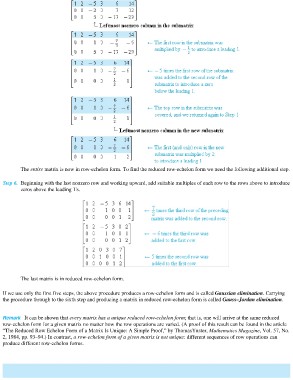
The entire matrix is now in row-echelon form. To find the reduced row-echelon form we need the following additional step.
Step 6. Beginning with the last nonzero row and working upward, add suitable multiples of each row to the rows above to introduce

          zeros above the leading 1's.

          The last matrix is in reduced row-echelon form.
If we use only the first five steps, the above procedure produces a row-echelon form and is called Gaussian elimination. Carrying
the procedure through to the sixth step and producing a matrix in reduced row-echelon form is called Gauss–Jordan elimination.
Remark It can be shown that every matrix has a unique reduced row-echelon form; that is, one will arrive at the same reduced
row-echelon form for a given matrix no matter how the row operations are varied. (A proof of this result can be found in the article
“The Reduced Row Echelon Form of a Matrix Is Unique: A Simple Proof,” by ThomasYuster, Mathematics Magazine, Vol. 57, No.
2, 1984, pp. 93–94.) In contrast, a row-echelon form of a given matrix is not unique: different sequences of row operations can
produce different row-echelon forms.

