


Page 218 - Elementary_Linear_Algebra_with_Applications_Anton__9_edition
P. 218
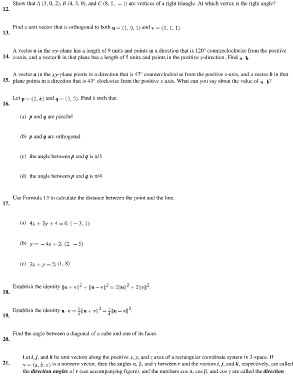
Show that A (3, 0, 2), B (4, 3, 0), and C (8, 1, ) are vertices of a right triangle. At which vertex is the right angle?
12.

     Find a unit vector that is orthogonal to both     and .
13.

     A vector a in the -plane has a length of 9 units and points in a direction that is 120° counterclockwise from the positive
14. x-axis, and a vector b in that plane has a length of 5 units and points in the positive y-direction. Find .

     A vector a in the -plane points in a direction that is 47° counterclockwise from the positive x-axis, and a vector b in that
15. plane points in a direction that is 43° clockwise from the positive x-axis. What can you say about the value of ?

     Let  and . Find k such that
16.

(a) p and q are parallel

(b) p and q are orthogonal

(c) the angle between p and q is π/3

(d) the angle between p and q is π/4

     Use Formula 13 to calculate the distance between the point and the line.
17.

         (a) ;

         (b) ;

         (c) ; (1, 8)

     Establish the identity                            .
18.

     Establish the identity                         .
19.

     Find the angle between a diagonal of a cube and one of its faces.
20.

          Let i, j, and k be unit vectors along the positive x, y, and z axes of a rectangular coordinate system in 3-space. If
21. is a nonzero vector, then the angles α, β, and γ between v and the vectors i, j, and k, respectively, are called

          the direction angles of v (see accompanying figure), and the numbers cos α, cos β, and cos γ are called the direction

