


Page 223 - Elementary_Linear_Algebra_with_Applications_Anton__9_edition
P. 223
Proof (d) and (e) See Exercises 26 and 27.

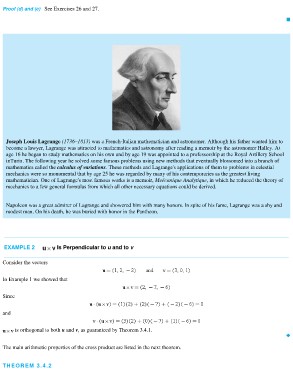
Joseph Louis Lagrange (1736–1813) was a French-Italian mathematician and astronomer. Although his father wanted him to
become a lawyer, Lagrange was attracted to mathematics and astronomy after reading a memoir by the astronomer Halley. At
age 16 he began to study mathematics on his own and by age 19 was appointed to a professorship at the Royal Artillery School
inTurin. The following year he solved some famous problems using new methods that eventually blossomed into a branch of
mathematics called the calculus of variations. These methods and Lagrange's applications of them to problems in celestial
mechanics were so monumental that by age 25 he was regarded by many of his contemporaries as the greatest living
mathematician. One of Lagrange's most famous works is a memoir, Meécanique Analytique, in which he reduced the theory of
mechanics to a few general formulas from which all other necessary equations could be derived.

Napoleon was a great admirer of Lagrange and showered him with many honors. In spite of his fame, Lagrange was a shy and
modest man. On his death, he was buried with honor in the Pantheon.

EXAMPLE 2             Is Perpendicular to u and to v

Consider the vectors

In Example 1 we showed that

Since

and

       is orthogonal to both u and v, as guaranteed by Theorem 3.4.1.

The main arithmetic properties of the cross product are listed in the next theorem.

THEOREM 3.4.2

