


Page 355 - Elementary_Linear_Algebra_with_Applications_Anton__9_edition
P. 355
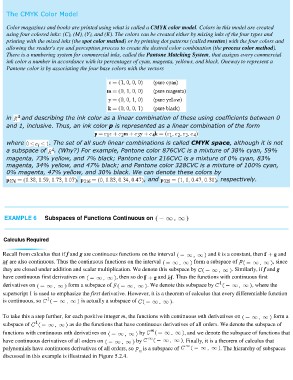
The CMYK Color Model

Color magazines and books are printed using what is called a CMYK color model. Colors in this model are created
using four colored inks: (C), (M), (Y), and (K). The colors can be created either by mixing inks of the four types and
printing with the mixed inks (the spot color method) or by printing dot patterns (called rosettes) with the four colors and
allowing the reader's eye and perception process to create the desired color combination (the process color method).
There is a numbering system for commercial inks, called the Pantone Matching System, that assigns every commercial
ink color a number in accordance with its percentages of cyan, magenta, yellows, and black. Oneway to represent a
Pantone color is by associating the four base colors with the vectors

in and describing the ink color as a linear combination of these using coefficients between 0
and 1, inclusive. Thus, an ink color p is represented as a linear combination of the form

where              . The set of all such linear combinations is called CMYK space, although it is not

a subspace of . (Why?) For example, Pantone color 876CVC is a mixture of 38% cyan, 59%

magenta, 73% yellow, and 7% black; Pantone color 216CVC is a mixture of 0% cyan, 83%
magenta, 34% yellow, and 47% black; and Pantone color 328CVC is a mixture of 100% cyan,
0% magenta, 47% yellow, and 30% black. We can denote these colors by

                   ,                                           , and                         , respectively.

EXAMPLE 6 Subspaces of Functions Continuous on

Calculus Required

Recall from calculus that if f and g are continuous functions on the interval         and k is a constant, then             and

are also continuous. Thus the continuous functions on the interval             form a subspace of                , since

they are closed under addition and scalar multiplication. We denote this subspace by         . Similarly, if f and g

have continuous first derivatives on          , then so do     and . Thus the functions with continuous first

derivatives on     form a subspace of                          . We denote this subspace by                 , where the

superscript 1 is used to emphasize the first derivative. However, it is a theorem of calculus that every differentiable function

is continuous, so     is actually a subspace of                       .

To take this a step further, for each positive integer m, the functions with continuous mth derivatives on       form a

subspace of        as do the functions that have continuous derivatives of all orders. We denote the subspace of

functions with continuous mth derivatives on               by                  , and we denote the subspace of functions that

have continuous derivatives of all orders on               by                  . Finally, it is a theorem of calculus that

polynomials have continuous derivatives of all orders, so is a subspace of                   . The hierarchy of subspaces

discussed in this example is illustrated in Figure 5.2.4.

