


Page 444 - Elementary_Linear_Algebra_with_Applications_Anton__9_edition
P. 444
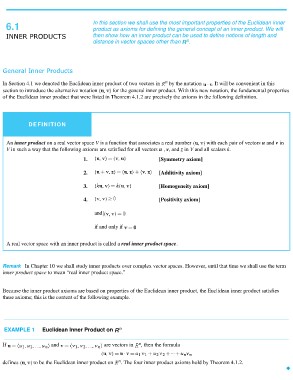
6.1                     In this section we shall use the most important properties of the Euclidean inner
                        product as axioms for defining the general concept of an inner product. We will
INNER PRODUCTS          then show how an inner product can be used to define notions of length and
                        distance in vector spaces other than .

General Inner Products

In Section 4.1 we denoted the Euclidean inner product of two vectors in by the notation . It will be convenient in this

section to introduce the alternative notation  for the general inner product. With this new notation, the fundamental properties

of the Euclidean inner product that were listed in Theorem 4.1.2 are precisely the axioms in the following definition.

         DEFINITION

An inner product on a real vector space V is a function that associates a real number  with each pair of vectors u and v in

V in such a way that the following axioms are satisfied for all vectors u , v, and z in V and all scalars k.

                        1. [Symmetry axiom]

                        2. [Additivity axiom]

                        3. [Homogeneity axiom]

                        4. [Positivity axiom]

                        and

                        if and only if

A real vector space with an inner product is called a real inner product space.

Remark In Chapter 10 we shall study inner products over complex vector spaces. However, until that time we shall use the term
inner product space to mean “real inner product space.”

Because the inner product axioms are based on properties of the Euclidean inner product, the Euclidean inner product satisfies
these axioms; this is the content of the following example.

EXAMPLE 1 Euclidean Inner Product on
If and are vectors in , then the formula

defines  to be the Euclidean inner product on . The four inner product axioms hold by Theorem 4.1.2.

