


Page 460 - Elementary_Linear_Algebra_with_Applications_Anton__9_edition
P. 460
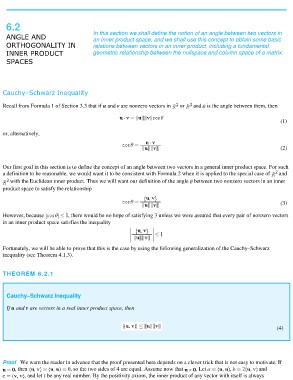
6.2                 In this section we shall define the notion of an angle between two vectors in
                    an inner product space, and we shall use this concept to obtain some basic
ANGLE AND           relations between vectors in an inner product, including a fundamental
ORTHOGONALITY IN    geometric relationship between the nullspace and column space of a matrix.
INNER PRODUCT
SPACES

Cauchy–Schwarz Inequality

Recall from Formula 1 of Section 3.3 that if u and v are nonzero vectors in or and is the angle between them, then

                                                                                                                         (1)

or, alternatively,

                                                                                                                         (2)

Our first goal in this section is to define the concept of an angle between two vectors in a general inner product space. For such
a definition to be reasonable, we would want it to be consistent with Formula 2 when it is applied to the special case of and

   with the Euclidean inner product. Thus we will want our definition of the angle between two nonzero vectors in an inner
product space to satisfy the relationship

                                                                                                                         (3)

However, because    , there would be no hope of satisfying 3 unless we were assured that every pair of nonzero vectors

in an inner product space satisfies the inequality

Fortunately, we will be able to prove that this is the case by using the following generalization of the Cauchy–Schwarz
inequality (see Theorem 4.1.3).

THEOREM 6.2.1

Cauchy–Schwarz Inequality
If u and v are vectors in a real inner product space, then

                                                                                                                         (4)

Proof We warn the reader in advance that the proof presented here depends on a clever trick that is not easy to motivate. If

, then              , so the two sides of 4 are equal. Assume now that . Let  ,  and

, and let t be any real number. By the positivity axiom, the inner product of any vector with itself is always

