


Page 498 - Elementary_Linear_Algebra_with_Applications_Anton__9_edition
P. 498
6.4                              In this section we shall show how orthogonal projections can be used to
                                 solve certain approximation problems. The results obtained in this section
BEST APPROXIMATION;              have a wide variety of applications in both mathematics and science.
LEAST SQUARES

Orthogonal Projections Viewed as Approximations

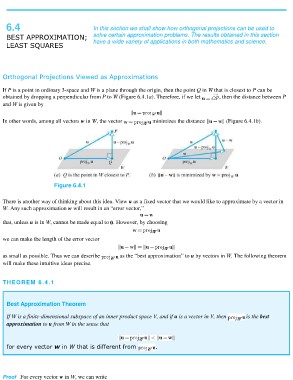
If P is a point in ordinary 3-space and W is a plane through the origin, then the point Q in W that is closest to P can be

obtained by dropping a perpendicular from P to W (Figure 6.4.1a). Therefore, if we let  , then the distance between P

and W is given by

In other words, among all vectors w in W, the vector  minimizes the distance            (Figure 6.4.1b).

                   Figure 6.4.1

There is another way of thinking about this idea. View u as a fixed vector that we would like to approximate by a vector in
W. Any such approximation w will result in an “error vector,”

that, unless u is in W, cannot be made equal to . However, by choosing

we can make the length of the error vector

as small as possible. Thus we can describe   as the “best approximation” to u by vectors in W. The following theorem
will make these intuitive ideas precise.

THEOREM 6.4.1

Best Approximation Theorem                                                                          is the best

If W is a finite-dimensional subspace of an inner product space V, and if u is a vector in V, then
approximation to u from W in the sense that

for every vector w in W that is different from        .

Proof For every vector w in W, we can write

