


Page 501 - Elementary_Linear_Algebra_with_Applications_Anton__9_edition
P. 501
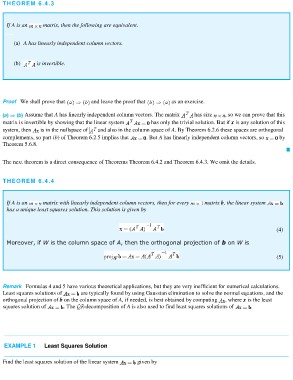
THEOREM 6.4.3

If A is an      matrix, then the following are equivalent.

(a) A has linearly independent column vectors.

(b) is invertible.

Proof We shall prove that   and leave the proof that              as an exercise.

Assume that A has linearly independent column vectors. The matrix has size , so we can prove that this

matrix is invertible by showing that the linear system          has only the trivial solution. But if x is any solution of this

system, then is in the nullspace of and also in the column space of A. By Theorem 6.2.6 these spaces are orthogonal

complements, so part (b) of Theorem 6.2.5 implies that          . But A has linearly independent column vectors, so   by

Theorem 5.6.8.

The next theorem is a direct consequence of Theorems Theorem 6.4.2 and Theorem 6.4.3. We omit the details.

THEOREM 6.4.4

If A is an      matrix with linearly independent column vectors, then for every  matrix b, the linear system

has a unique least squares solution. This solution is given by

Moreover, if W is the column space of A, then the orthogonal projection of b on W is                                  (4)
                                                                                                                      (5)

Remark Formulas 4 and 5 have various theoretical applications, but they are very inefficient for numerical calculations.

Least squares solutions of  are typically found by using Gaussian elimination to solve the normal equations, and the

orthogonal projection of b on the column space of A, if needed, is best obtained by computing , where x is the least

squares solution of         . The -decomposition of A is also used to find least squares solutions of  .

EXAMPLE 1 Least Squares Solution                        given by
Find the least squares solution of the linear system

