


Page 512 - Elementary_Linear_Algebra_with_Applications_Anton__9_edition
P. 512
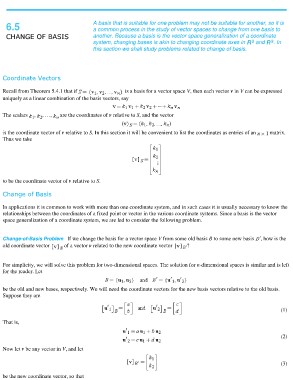
6.5                                    A basis that is suitable for one problem may not be suitable for another, so it is
                                       a common process in the study of vector spaces to change from one basis to
CHANGE OF BASIS                        another. Because a basis is the vector space generalization of a coordinate
                                       system, changing bases is akin to changing coordinate axes in and . In
                                       this section we shall study problems related to change of basis.

Coordinate Vectors

Recall from Theorem 5.4.1 that if      is a basis for a vector space V, then each vector v in V can be expressed

uniquely as a linear combination of the basis vectors, say

The scalars , , …, are the coordinates of v relative to S, and the vector

is the coordinate vector of v relative to S. In this section it will be convenient to list the coordinates as entries of an  matrix.
Thus we take

to be the coordinate vector of v relative to S.

Change of Basis

In applications it is common to work with more than one coordinate system, and in such cases it is usually necessary to know the
relationships between the coordinates of a fixed point or vector in the various coordinate systems. Since a basis is the vector
space generalization of a coordinate system, we are led to consider the following problem.

Change-of-Basis Problem If we change the basis for a vector space V from some old basis B to some new basis , how is the

old coordinate vector  of a vector v related to the new coordinate vector  ?

For simplicity, we will solve this problem for two-dimensional spaces. The solution for n-dimensional spaces is similar and is left
for the reader. Let

be the old and new bases, respectively. We will need the coordinate vectors for the new basis vectors relative to the old basis.
Suppose they are

                                                                                                                                  (1)

That is,

                                                                                                                                  (2)

Now let v be any vector in V, and let

                                                                                                                                  (3)

be the new coordinate vector, so that

