


Page 513 - Elementary_Linear_Algebra_with_Applications_Anton__9_edition
P. 513
(4)
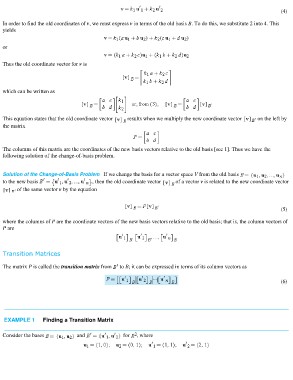
In order to find the old coordinates of v, we must express v in terms of the old basis B. To do this, we substitute 2 into 4. This
yields

or

Thus the old coordinate vector for v is

which can be written as

This equation states that the old coordinate vector  results when we multiply the new coordinate vector        on the left by
the matrix

The columns of this matrix are the coordinates of the new basis vectors relative to the old basis [see 1]. Thus we have the
following solution of the change-of-basis problem.

Solution of the Change-of-Basis Problem If we change the basis for a vector space V from the old basis

to the new basis              , then the old coordinate vector    of a vector v is related to the new coordinate vector

of the same vector v by the equation

                                                                                                                                                        (5)

where the columns of P are the coordinate vectors of the new basis vectors relative to the old basis; that is, the column vectors of
P are

Transition Matrices

The matrix P is called the transition matrix from to B; it can be expressed in terms of its column vectors as

                                                                                                                             (6)

EXAMPLE 1 Finding a Transition Matrix

Consider the bases       and                         for , where

