


Page 539 - Elementary_Linear_Algebra_with_Applications_Anton__9_edition
P. 539
or, equivalently,

                                                                                                                        (1)

For to be an eigenvalue, there must be a nonzero solution of this equation. By Theorem 6.4.5, Equation 1 has a nonzero
solution if and only if

This is called the characteristic equation of A; the scalars satisfying this equation are the eigenvalues of A. When expanded, the

determinant        is always a polynomial p in , called the characteristic polynomial of A.

It can be shown (Exercise 15) that if A is an matrix, then the characteristic polynomial of A has degree n and the coefficient
of is 1; that is, the characteristic polynomial of an matrix has the form

It follows from the Fundamental Theorem of Algebra that the characteristic equation

has at most n distinct solutions, so an matrix has at most n distinct eigenvalues.           matrix by solving the

The reader may wish to review Example 6 of Section 2.3, where we found the eigenvalues of a
characteristic equation. The following example involves a matrix.

EXAMPLE 2 Eigenvalues of a             Matrix
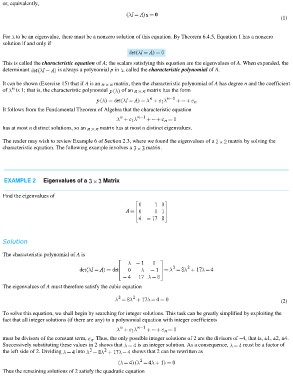
Find the eigenvalues of

Solution

The characteristic polynomial of A is

The eigenvalues of A must therefore satisfy the cubic equation

                                                                                                                                                       (2)
To solve this equation, we shall begin by searching for integer solutions. This task can be greatly simplified by exploiting the
fact that all integer solutions (if there are any) to a polynomial equation with integer coefficients

must be divisors of the constant term, . Thus, the only possible integer solutions of 2 are the divisors of −4, that is, ±1, ±2, ±4.

Successively substituting these values in 2 shows that  is an integer solution. As a consequence,  must be a factor of

the left side of 2. Dividing  into                      shows that 2 can be rewritten as

Thus the remaining solutions of 2 satisfy the quadratic equation

