


Page 574 - Elementary_Linear_Algebra_with_Applications_Anton__9_edition
P. 574
is not diagonalizable.
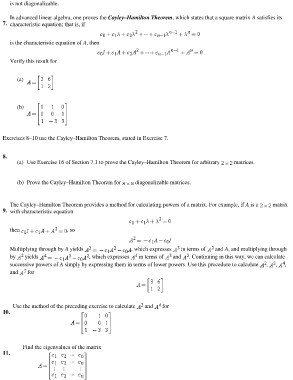
   In advanced linear algebra, one proves the Cayley–Hamilton Theorem, which states that a square matrix A satisfies its
7. characteristic equation; that is, if
   is the characteristic equation of A, then
   Verify this result for

       (a)

       (b)

Exercises 8–10 use the Cayley–Hamilton Theorem, stated in Exercise 7.

8.                                                                                            matrices.
       (a) Use Exercise 16 of Section 7.1 to prove the Cayley–Hamilton Theorem for arbitrary

(b) Prove the Cayley–Hamilton Theorem for diagonalizable matrices.

   The Cayley–Hamilton Theorem provides a method for calculating powers of a matrix. For example, if A is a  matrix
9. with characteristic equation

then , so

Multiplying through by A yields               , which expresses in terms of and A, and multiplying through

by yields                        , which expresses in terms of and . Continuing in this way, we can calculate

successive powers of A simply by expressing them in terms of lower powers. Use this procedure to calculate , , ,

and for

     Use the method of the preceding exercise to calculate and for
10.

          Find the eigenvalues of the matrix
11.

