


Page 606 - Elementary_Linear_Algebra_with_Applications_Anton__9_edition
P. 606
Let

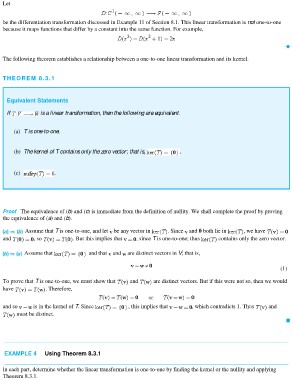
be the differentiation transformation discussed in Example 11 of Section 8.1. This linear transformation is not one-to-one
because it maps functions that differ by a constant into the same function. For example,

The following theorem establishes a relationship between a one-to-one linear transformation and its kernel.
THEOREM 8.3.1

Equivalent Statements
If is a linear transformation, then the following are equivalent.

   (a) T is one-to-one.

(b) The kernel of T contains only the zero vector; that is,    .

(c) .

Proof The equivalence of (b) and (c) is immediate from the definition of nullity. We shall complete the proof by proving
the equivalence of (a) and (b).

        Assume that T is one-to-one, and let be any vector in  . Since and 0 both lie in  , we have

and , so             . But this implies that , since T is one-to-one; thus  contains only the zero vector.

        Assume that  and that and are distinct vectors in V; that is,

                                                                                                                                                  (1)

To prove that T is one-to-one, we must show that and are distinct vectors. But if this were not so, then we would
have . Therefore,

and so  is in the kernel of T. Since  , this implies that          , which contradicts 1. Thus and

must be distinct.

EXAMPLE 4 Using Theorem 8.3.1

In each part, determine whether the linear transformation is one-to-one by finding the kernel or the nullity and applying
Theorem 8.3.1.

