


Page 609 - Elementary_Linear_Algebra_with_Applications_Anton__9_edition
P. 609
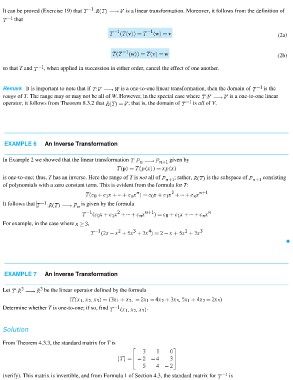
It can be proved (Exercise 19) that               is a linear transformation. Moreover, it follows from the definition of
      that                                                                                                                        (2a)

                                                                                                                    (2b)

so that T and , when applied in succession in either order, cancel the effect of one another.

Remark It is important to note that if            is a one-to-one linear transformation, then the domain of is the

range of T. The range may or may not be all of W. However, in the special case where           is a one-to-one linear

operator, it follows from Theorem 8.3.2 that      ; that is, the domain of is all of V.

EXAMPLE 6 An Inverse Transformation                       given by
In Example 2 we showed that the linear transformation

is one-to-one; thus, T has an inverse. Here the range of T is not all of ; rather,    is the subspace of  consisting
of polynomials with a zero constant term. This is evident from the formula for T:

It follows that  is given by the formula

For example, in the case where ,

EXAMPLE 7 An Inverse Transformation
Let be the linear operator defined by the formula

Determine whether T is one-to-one; if so, find         .

Solution

From Theorem 4.3.3, the standard matrix for T is

(verify). This matrix is invertible, and from Formula 1 of Section 4.3, the standard matrix for is

