


Page 608 - Elementary_Linear_Algebra_with_Applications_Anton__9_edition
P. 608
Proof We already know that (a), (b), and (c) are equivalent, so we can complete the proof by proving the equivalence of (c)
and (d).

         Suppose that  and      . It follows from the Dimension Theorem (Theorem 8.2.3) that

By definition,         is the dimension of the range of T, so the range of T has dimension n. It now follows from Theorem

5.4.7 that the range of T is V , since the two spaces have the same dimension.

         Suppose that  and . It follows from these relationships that                                 , or, equivalently,

         . Thus it follows from the Dimension Theorem (Theorem 8.2.3) that

EXAMPLE 5 A Transformation That Is Not One-To-One
Let be multiplication by

Determine whether is one-to-one.                                                                      , since the

Solution

As noted in Example 1, the given problem is equivalent to determining whether A is invertible. But
first two rows of A are proportional, and consequently, A is not invertible. Thus is not one-to-one.

Inverse Linear Transformations

In Section 4.3 we defined the inverse of a one-to-one matrix operator           to be                 , and we
showed that if is the image of a vector under , then
to general linear transformations.                                     maps     back into . We shall now extend these ideas

Recall that if         is a linear transformation, then the range of T, denoted by , is the subspace of W consisting of

all images under T of vectors in V. If T is one-to-one, then each vector in is the image of a unique vector in V. This

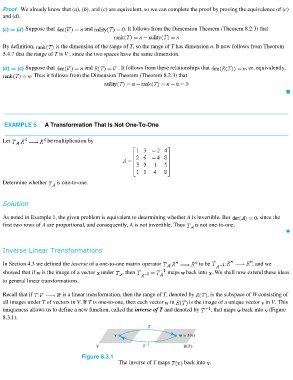
uniqueness allows us to define a new function, called the inverse of T and denoted by , that maps back into (Figure

8.3.1).

                       Figure 8.3.1                                             back into .
                                          The inverse of T maps

