


Page 665 - Elementary_Linear_Algebra_with_Applications_Anton__9_edition
P. 665
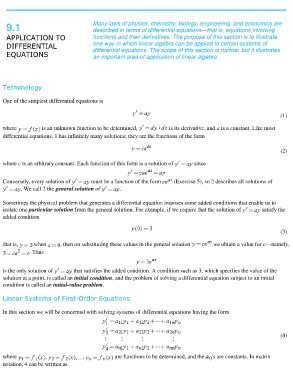
9.1                               Many laws of physics, chemistry, biology, engineering, and economics are
                                  described in terms of differential equations—that is, equations involving
APPLICATION TO                    functions and their derivatives. The purpose of this section is to illustrate
DIFFERENTIAL                      one way in which linear algebra can be applied to certain systems of
EQUATIONS                         differential equations. The scope of this section is narrow, but it illustrates
                                  an important area of application of linear algebra.

Terminology

One of the simplest differential equations is

                                                                                                                               (1)

where            is an unknown function to be determined,         is its derivative, and a is a constant. Like most

differential equations, 1 has infinitely many solutions; they are the functions of the form

                                                                                                                               (2)

where c is an arbitrary constant. Each function of this form is a solution of         since

Conversely, every solution of     must be a function of the form               (Exercise 5), so 2 describes all solutions of

          . We call 2 the general solution of  .

Sometimes the physical problem that generates a differential equation imposes some added conditions that enable us to

isolate one particular solution from the general solution. For example, if we require that the solution of  satisfy the

added condition

that is,    when         , then on substituting these values in the general solution                                            (3)
          . Thus                                                                             we obtain a value for c—namely,

is the only solution of        that satisfies the added condition. A condition such as 3, which specifies the value of the

solution at a point, is called an initial condition, and the problem of solving a differential equation subject to an initial

condition is called an initial-value problem.

Linear Systems of First-Order Equations

In this section we will be concerned with solving systems of differential equations having the form

where            ,             ,                                                                                                      (4)
                                               are functions to be determined, and the 's are constants. In matrix

notation, 4 can be written as

