


Page 667 - Elementary_Linear_Algebra_with_Applications_Anton__9_edition
P. 667
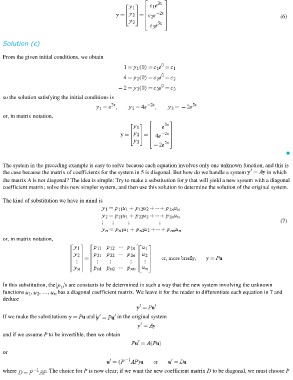
(6)

Solution (c)

From the given initial conditions, we obtain

so the solution satisfying the initial conditions is
or, in matrix notation,

The system in the preceding example is easy to solve because each equation involves only one unknown function, and this is

the case because the matrix of coefficients for the system in 5 is diagonal. But how do we handle a system  in which

the matrix A is not diagonal? The idea is simple: Try to make a substitution for y that will yield a new system with a diagonal
coefficient matrix; solve this new simpler system, and then use this solution to determine the solution of the original system.

The kind of substitution we have in mind is

                                                                                                            (7)

or, in matrix notation,

In this substitution, the 's are constants to be determined in such a way that the new system involving the unknown
functions , , …, has a diagonal coefficient matrix. We leave it for the reader to differentiate each equation in 7 and
deduce

If we make the substitutions  and                     in the original system

and if we assume P to be invertible, then we obtain
or

where  . The choice for P is now clear; if we want the new coefficient matrix D to be diagonal, we must choose P

