


Page 700 - Elementary_Linear_Algebra_with_Applications_Anton__9_edition
P. 700
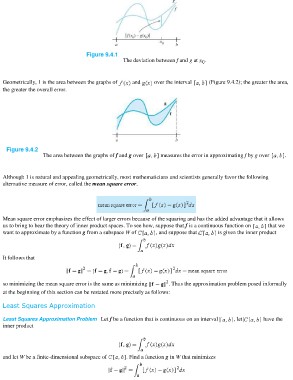
Figure 9.4.1
                                    The deviation between f and g at .

Geometrically, 1 is the area between the graphs of  and over the interval           (Figure 9.4.2); the greater the area,
the greater the overall error.

Figure 9.4.2                                                    measures the error in approximating f by g over              .
                   The area between the graphs of f and g over

Although 1 is natural and appealing geometrically, most mathematicians and scientists generally favor the following
alternative measure of error, called the mean square error.

Mean square error emphasizes the effect of larger errors because of the squaring and has the added advantage that it allows

us to bring to bear the theory of inner product spaces. To see how, suppose that f is a continuous function on  that we

want to approximate by a function g from a subspace W of        , and suppose that           is given the inner product

It follows that

so minimizing the mean square error is the same as minimizing   . Thus the approximation problem posed informally

at the beginning of this section can be restated more precisely as follows:

Least Squares Approximation

Least Squares Approximation Problem Let f be a function that is continuous on an interval    , let              have the
inner product

and let W be a finite-dimensional subspace of       . Find a function g in W that minimizes

