


Page 701 - Elementary_Linear_Algebra_with_Applications_Anton__9_edition
P. 701
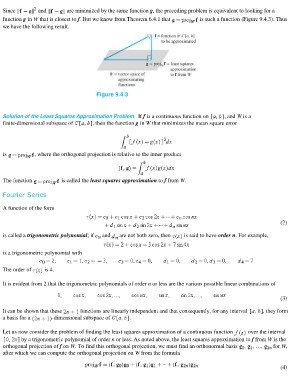
Since          and are minimized by the same function g, the preceding problem is equivalent to looking for a

function g in W that is closest to f. But we know from Theorem 6.4.1 that       is such a function (Figure 9.4.3). Thus

we have the following result.

                                    Figure 9.4.3

Solution of the Least Squares Approximation Problem If f is a continuous function on  , and W is a

finite-dimensional subspace of      , then the function g in W that minimizes the mean square error

is , where the orthogonal projection is relative to the inner product

The function            is called the least squares approximation to f from W.

Fourier Series

A function of the form

                                                                                                                            (2)

is called a trigonometric polynomial; if and are not both zero, then is said to have order n. For example,

is a trigonometric polynomial with

The order of is 4.

It is evident from 2 that the trigonometric polynomials of order n or less are the various possible linear combinations of

It can be shown that these      functions are linearly independent and that consequently, for any interval           (3)
                                                                                                            , they form

a basis for a   -dimensional subspace of          .

Let us now consider the problem of finding the least squares approximation of a continuous function         over the interval

       by a trigonometric polynomial of order n or less. As noted above, the least squares approximation to f from W is the

orthogonal projection of f on W. To find this orthogonal projection, we must find an orthonormal basis , , …, for W,

after which we can compute the orthogonal projection on W from the formula

                                                                                                                            (4)

