


Page 746 - Elementary_Linear_Algebra_with_Applications_Anton__9_edition
P. 746
(9)

                                                                                                                           (10)

Comparison of Methods for Solving Linear Systems

In practical applications it is common to encounter linear systems with thousands of equations in thousands of unknowns. Thus we

shall be interested in Table 1 for large values of n. It is a fact about polynomials that for large values of the variable, a polynomial

can be approximated well by its term of highest degree; that is, if  , then

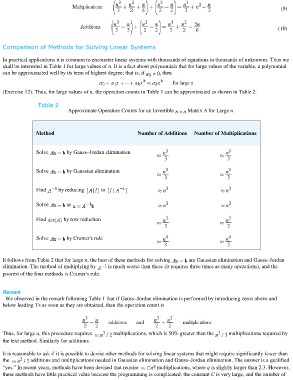
(Exercise 12). Thus, for large values of n, the operation counts in Table 1 can be approximated as shown in Table 2.

Table 2                                                                          Matrix A for Large n

                Approximate Operation Counts for an Invertible

Method                                             Number of Additions Number of Multiplications

Solve   by Gauss–Jordan elimination

Solve   by Gaussian elimination

Find by reducing                               to

Solve   as

Find by row reduction

Solve   by Cramer's rule

It follows from Table 2 that for large n, the best of these methods for solving  are Gaussian elimination and Gauss–Jordan

elimination. The method of multiplying by is much worse than these (it requires three times as many operations), and the

poorest of the four methods is Cramer's rule.

Remark

 We observed in the remark following Table 1 that if Gauss–Jordan elimination is performed by introducing zeros above and
below leading 1's as soon as they are obtained, then the operation count is

Thus, for large n, this procedure requires         multiplications, which is 50% greater than the  multiplications required by
the text method. Similarly for additions.

It is reasonable to ask if it is possible to devise other methods for solving linear systems that might require significantly fewer than

the additions and multiplications needed in Gaussian elimination and Gauss–Jordan elimination. The answer is a qualified

“yes.” In recent years, methods have been devised that require       multiplications, where q is slightly larger than 2.3. However,

these methods have little practical value because the programming is complicated, the constant C is very large, and the number of

