


Page 741 - Elementary_Linear_Algebra_with_Applications_Anton__9_edition
P. 741
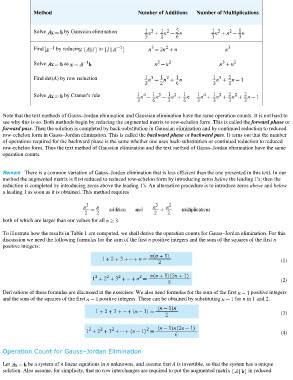
Method                                       Number of Additions Number of Multiplications

Solve   by Gaussian elimination

Find by reducing                         to

Solve   as

Find det(A) by row reduction

Solve   by Cramer's rule

Note that the text methods of Gauss–Jordan elimination and Gaussian elimination have the same operation counts. It is not hard to
see why this is so. Both methods begin by reducing the augmented matrix to row-echelon form. This is called the forward phase or
forward pass. Then the solution is completed by back-substitution in Gaussian elimination and by continued reduction to reduced
row-echelon form in Gauss–Jordan elimination. This is called the backward phase or backward pass. It turns out that the number
of operations required for the backward phase is the same whether one uses back-substitution or continued reduction to reduced
row-echelon form. Thus the text method of Gaussian elimination and the text method of Gauss–Jordan elimination have the same
operation counts.

Remark There is a common variation of Gauss–Jordan elimination that is less efficient than the one presented in this text. In our
method the augmented matrix is first reduced to reduced row-echelon form by introducing zeros below the leading 1's; then the
reduction is completed by introducing zeros above the leading 1's. An alternative procedure is to introduce zeros above and below
a leading 1 as soon as it is obtained. This method requires

both of which are larger than our values for all .

To illustrate how the results in Table 1 are computed, we shall derive the operation counts for Gauss–Jordan elimination. For this
discussion we need the following formulas for the sum of the first n positive integers and the sum of the squares of the first n
positive integers:

                                                                                                                                                          (1)

                                                                                                                             (2)

Derivations of these formulas are discussed in the exercises. We also need formulas for the sum of the first  positive integers

and the sum of the squares of the first  positive integers. These can be obtained by substituting         for n in 1 and 2.

                                                                                                                             (3)

                                                                                                                             (4)

Operation Count for Gauss–Jordan Elimination

Let be a system of n linear equations in n unknowns, and assume that A is invertible, so that the system has a unique

solution. Also assume, for simplicity, that no row interchanges are required to put the augmented matrix      in reduced

