


Page 85 - Elementary_Linear_Algebra_with_Applications_Anton__9_edition
P. 85
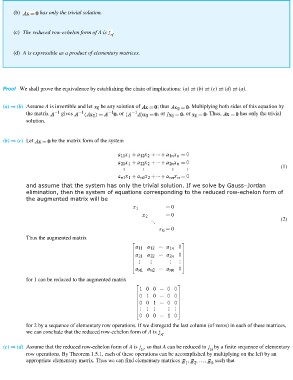
(b) has only the trivial solution.
(c) The reduced row-echelon form of A is .
(d) A is expressible as a product of elementary matrices.

Proof We shall prove the equivalence by establishing the chain of implications: (a) (b) (c) (d) (a).

(a) (b) Assume A is invertible and let be any solution of  ; thus  . Multiplying both sides of this equation by
                                                           , or
the matrix gives           , or                                    , or . Thus,  has only the trivial

solution.

(b) (c) Let  be the matrix form of the system

                                                                                                                                           (1)

and assume that the system has only the trivial solution. If we solve by Gauss–Jordan
elimination, then the system of equations corresponding to the reduced row-echelon form of
the augmented matrix will be

                                                                                                      (2)

Thus the augmented matrix

for 1 can be reduced to the augmented matrix

            for 2 by a sequence of elementary row operations. If we disregard the last column (of zeros) in each of these matrices,
            we can conclude that the reduced row-echelon form of A is .

(c) (d) Assume that the reduced row-echelon form of A is , so that A can be reduced to by a finite sequence of elementary
            row operations. By Theorem 1.5.1, each of these operations can be accomplished by multiplying on the left by an
            appropriate elementary matrix. Thus we can find elementary matrices , , …, such that

