


Page 86 - Elementary_Linear_Algebra_with_Applications_Anton__9_edition
P. 86
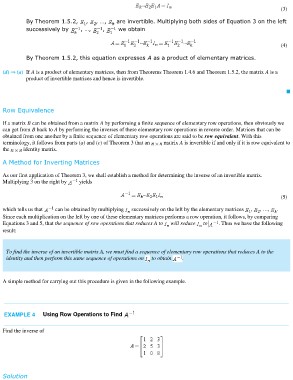
By Theorem 1.5.2, , , …,                                                                                            (3)
successively by , …, ,
                          are invertible. Multiplying both sides of Equation 3 on the left
                          we obtain

                                                                                                                         (4)

By Theorem 1.5.2, this equation expresses A as a product of elementary matrices.

(d) (a) If A is a product of elementary matrices, then from Theorems Theorem 1.4.6 and Theorem 1.5.2, the matrix A is a
            product of invertible matrices and hence is invertible.

Row Equivalence

If a matrix B can be obtained from a matrix A by performing a finite sequence of elementary row operations, then obviously we
can get from B back to A by performing the inverses of these elementary row operations in reverse order. Matrices that can be
obtained from one another by a finite sequence of elementary row operations are said to be row equivalent. With this
terminology, it follows from parts (a) and (c) of Theorem 3 that an matrix A is invertible if and only if it is row equivalent to
the identity matrix.

A Method for Inverting Matrices

As our first application of Theorem 3, we shall establish a method for determining the inverse of an invertible matrix.
Multiplying 3 on the right by yields

                                                                                                                                                        (5)

which tells us that can be obtained by multiplying successively on the left by the elementary matrices , , …, .
Since each multiplication on the left by one of these elementary matrices performs a row operation, it follows, by comparing
Equations 3 and 5, that the sequence of row operations that reduces A to will reduce to . Thus we have the following
result:

 To find the inverse of an invertible matrix A, we must find a sequence of elementary row operations that reduces A to the
 identity and then perform this same sequence of operations on to obtain .

A simple method for carrying out this procedure is given in the following example.

EXAMPLE 4 Using Row Operations to Find
Find the inverse of

Solution

