


Page 142 - C:\Users\trainee\AppData\Local\Temp\msoEAA3.tmp
P. 142
Fundamentals of Stress and Vibration                1. Mathematics for Structural mechanics
                 [A Practical guide for aspiring Designers / Analysts]
               Let us compute the rate of change of the tangent unit vector  T .


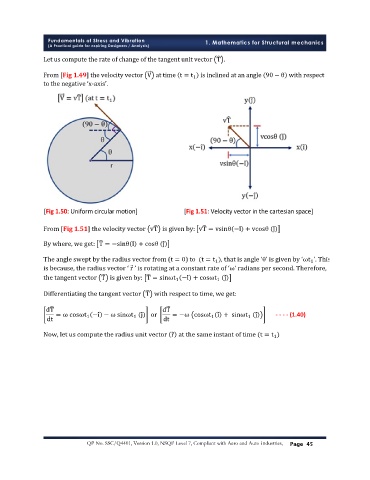
               From [Fig 1.49] the velocity vector  V  at time  t = t   is inclined at an angle  90 − θ  with respect
                                                                 1
               to the negative ‘x-axis’.


                [Fig 1.50: Uniform circular motion]           [Fig 1.51: Velocity vector in the cartesian space]

               From [Fig 1.51] the velocity vector  vT  is given by:  vT = vsinθ −i   + vcosθ  j


               By where, we get:  T = −sinθ i   + cosθ  j


               The angle swept by the radius vector from (t = 0) to  (t = t ), that is angle ‘θ’ is given by ‘ωt ’. This
                                                                        1
                                                                                                        1
               is because, the radius vector ‘ r  ’ is rotating at a constant rate of ‘ω’ radians per second. Therefore,

               the tangent vector  T  is given by:  T = sinωt  −i   + cosωt   j

                                                                         1
                                                           1
               Differentiating the tangent vector  T  with respect to time, we get:


                dT                                     dT
                   = ω cosωt  −i   − ω sinωt   j     or     = −ω  cosωt  i   +  sinωt   j       - - - - (1.40)
                                                                                   1
                              1
                                             1
                                                                       1
                 dt                                    dt
               Now, let us compute the radius unit vector  r   at the same instant of time (t = t )
                                                                                            1


                              QP No. SSC/Q4401, Version 1.0, NSQF Level 7, Compliant with Aero and Auto Industries,   Page 45

