


Page 141 - C:\Users\trainee\AppData\Local\Temp\msoEAA3.tmp
P. 141
Fundamentals of Stress and Vibration
[A Practical guide for aspiring Designers / Analysts] 1. Mathematics for Structural mechanics
ͳǤͺ
Vector differentiation is found to be naturally needed in several cases, such as, rate of change
of velocity, momentum, angular momentum, and many other vectors.
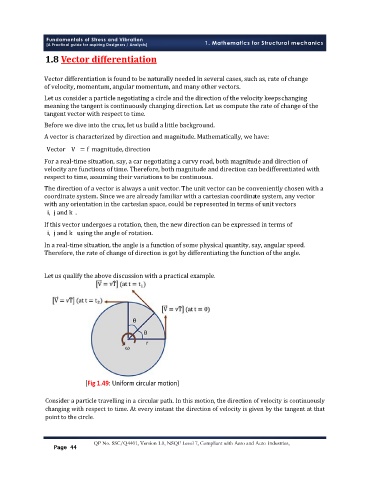
Let us consider a particle negotiating a circle and the direction of the velocity keeps changing
meaning the tangent is continuously changing direction. Let us compute the rate of change of the
tangent vector with respect to time.
Before we dive into the crux, let us build a little background.
A vector is characterized by direction and magnitude. Mathematically, we have:
Vector V = f magnitude, direction
For a real-time situation, say, a car negotiating a curvy road, both magnitude and direction of
velocity are functions of time. Therefore, both magnitude and direction can be differentiated with
respect to time, assuming their variations to be continuous.
The direction of a vector is always a unit vector. The unit vector can be conveniently chosen with a
coordinate system. Since we are already familiar with a cartesian coordinate system, any vector
with any orientation in the cartesian space, could be represented in terms of unit vectors
i, j and k .
If this vector undergoes a rotation, then, the new direction can be expressed in terms of
i, j and k using the angle of rotation.
In a real-time situation, the angle is a function of some physical quantity, say, angular speed.
Therefore, the rate of change of direction is got by differentiating the function of the angle.
Let us qualify the above discussion with a practical example.
[Fig 1.49: Uniform circular motion]
Ǥ ǡ
Ǥ
Ǥ
QP No. SSC/Q4401, Version 1.0, NSQF Level 7, Compliant with Aero and Auto Industries,
Page 44

