


Page 143 - C:\Users\trainee\AppData\Local\Temp\msoEAA3.tmp
P. 143
Fundamentals of Stress and Vibration
                [A Practical guide for aspiring Designers / Analysts]   1. Mathematics for Structural mechanics


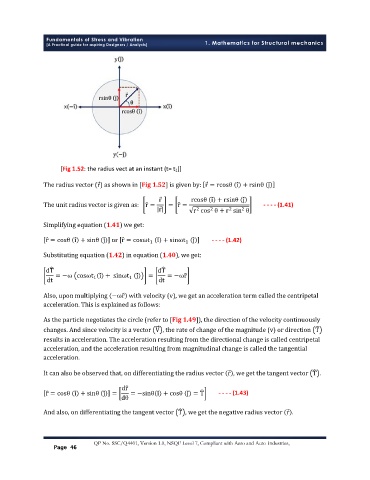
                     [Fig 1.52: the radius vect at an instant (t= t1)]

               The radius vector (r ) as shown in [Fig 1.52] is given by:  r  = rcosθ  i   + rsinθ  j

                                                      r         rcosθ  i   + rsinθ  j
               The unit radius vector is given as:    r  =    =  r  =                   - - - - (1.41)
                                                      r          r cos θ + r sin θ
                                                                  2
                                                                                 2
                                                                             2
                                                                       2
               Simplifying equation (1.41) we get:
                r  = cosθ  i   + sinθ  j    or  r  = cosωt   i   + sinωt   j      - - - - (1.42)
                                                              1
                                                   1
               Substituting equation (1.42) in equation (1.40), we get:


                dT                                   dT
                   = −ω  cosωt  i   +  sinωt   j     =    = −ωr
                                1
                                            1
                 dt                                  dt
               Also, upon multiplying  −ωr   with velocity (v), we get an acceleration term called the centripetal
               acceleration. This is explained as follows:
               As the particle negotiates the circle (refer to [Fig 1.49]), the direction of the velocity continuously


               changes. And since velocity is a vector  V , the rate of change of the magnitude (v) or direction  T
               results in acceleration. The acceleration resulting from the directional change is called centripetal
               acceleration, and the acceleration resulting from magnitudinal change is called the tangential
               acceleration.


               It can also be observed that, on differentiating the radius vector  r  , we get the tangent vector  T .
                                         dr

                r  = cosθ  i   + sinθ  j    =    = −sinθ i   + cosθ  j   = T    - - - - (1.43)
                                         dθ

               And also, on differentiating the tangent vector  T , we get the negative radius vector  r  .


                                QP No. SSC/Q4401, Version 1.0, NSQF Level 7, Compliant with Aero and Auto Industries,
                   Page 46

