


Page 91 - C:\Users\trainee\AppData\Local\Temp\msoEAA3.tmp
P. 91
Document Title
Fundamentals of Stress and Vibration 2. Engineering Mechanics Chapter
[A Practical guide for aspiring Designers / Analysts]
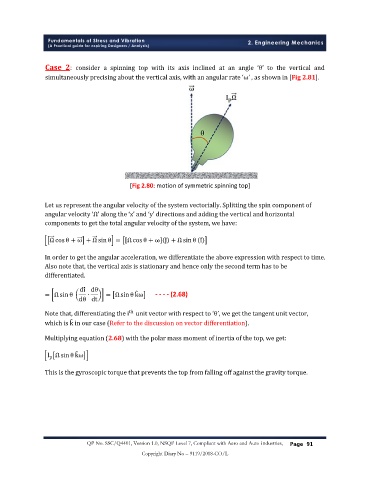
ʹǣ
ǮɅǯ
ǡ Ǯɘǯ ǡ ȏ ʹǤͺͳȐǤ
[Fig 2.80: motion of symmetric spinning top]
Let us represent the angular velocity of the system vectorially. Splitting the spin component of
angular velocity ‘Ω’ along the ‘x’ and ‘y’ directions and adding the vertical and horizontal
components to get the total angular velocity of the system, we have:
Ω cosθ + ω + Ω sin θ = Ω cosθ + ω j + Ω sin θ i
In order to get the angular acceleration, we differentiate the above expression with respect to time.
Also note that, the vertical axis is stationary and hence only the second term has to be
differentiated.
di dθ
= Ω sin θ ∙ = Ω sin θ kω - - - - (2.68)
dθ dt
Note that, differentiating the i unit vector with respect to ‘θ’, we get the tangent unit vector,
th
which is k in our case (Refer to the discussion on vector differentiation).
Multiplying equation (2.68) with the polar mass moment of inertia of the top, we get:
I Ω sin θ kω
p
This is the gyroscopic torque that prevents the top from falling off against the gravity torque.
QP No. SSC/Q4401, Version 1.0, NSQF Level 7, Compliant with Aero and Auto Industries, Page 91 age 91
P
Copyright Diary No – 9119/2018-CO/L

