


Page 96 - C:\Users\trainee\AppData\Local\Temp\msoEAA3.tmp
P. 96
Document Title
                Fundamentals of Stress and Vibration                                  Chapter Title
                [A Practical guide for aspiring Designers / Analysts]              2. Engineering Mechanics


                 Let us find the reactions at the supports by taking moments about the bearing support 1.

                                 L   d                                Mg
                   R ∗ L  =  Mg   +    +  mg L + d    =   R ∗ L  =        L + d   +  mg L + d
                    2
                                 2   2                       2         2

                                      Mg                      d   Mg
                 =   R ∗ L  =  L + d      + mg   =  R =  1 +          + mg      - - - - (2.69)
                      2
                                       2              2        L   2
                 From vertical force balance we have:


                                                               d   Mg
                  R = Mg + mg − R   =  R = Mg + mg −   1 +            + mg       - - - - (2.70)
                   1
                                          1
                                   2
                                                               L    2
                 Since the disc-shaft system is spinning and precessing, it experiences a torque about the ‘z-axis’,
                 called the gyroscopic torque and is given by:

                  Gyroscopic torque = ω j   × Ω i  I = ωΩI −k
                 Since gyroscopic moment is an inertial moment, the reactive moment is considered, which is:

                  Gyroscopic torque = ωΩI k    - - - - (2.71)

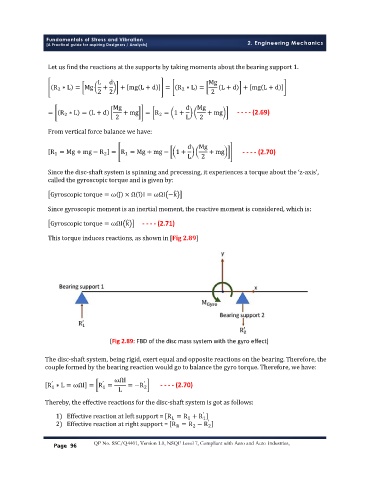
                 This torque induces reactions, as shown in [Fig 2.89]


                                     [Fig 2.89: FBD of the disc mass system with the gyro effect]

                The disc-shaft system, being rigid, exert equal and opposite reactions on the bearing. Therefore, the
                couple formed by the bearing reaction would go to balance the gyro torque. Therefore, we have:

                                       ωΩI
                                                 ′
                  ′
                                   ′
                 R ∗ L = ωΩI  =  R =       = −R       - - - - (2.70)
                  1
                                                 2
                                   1
                                        L
                Thereby, the effective reactions for the disc-shaft system is got as follows:
                    1)  Effective reaction at left support =  R = R + R
                                                                    ′
                                                               1
                                                                    1
                                                          L
                                                                      ′
                    2)  Effective reaction at right support =  R = R − R
                                                                      2
                                                           R
                                                                 2

                   Page 96      QP No. SSC/Q4401, Version 1.0, NSQF Level 7, Compliant with Aero and Auto Industries,

