


Page 102 - Fisika Terapan for Engineers and Scientists
P. 102
302                                CHAPTER 9  Gravitation


                **73. Repeat the calculations of Problem 72 for the case of a space-  (b) Show that the spacecraft will not gain any speed in this
                    craft launched on a trip to Venus. The orbit of Venus has a  encounter if     0, and show that the spacecraft will gain
                                  8
                    radius of 1.08   10 km.                                 maximum speed if     180 .
                **74. If a spacecraft, or some other body, approaches a moving  (c) If a spacecraft with v   3.0 km/s approaches Jupiter at an
                    planet on a hyperbolic orbit, it can gain some energy from the  angle of     20 , what will be its final speed?
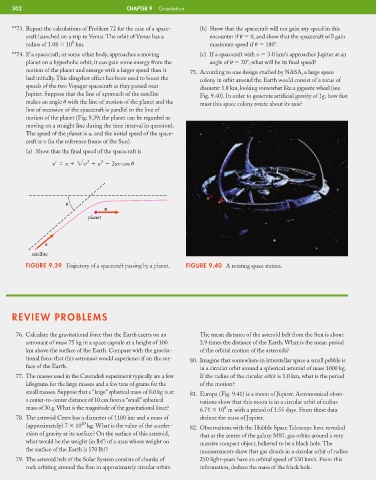
                    motion of the planet and emerge with a larger speed than it  75. According to one design studied by NASA, a large space
                    had initially. This slingshot effect has been used to boost the  colony in orbit around the Earth would consist of a torus of
                    speeds of the two Voyager spacecraft as they passed near  diameter 1.8 km, looking somewhat like a gigantic wheel (see
                    Jupiter. Suppose that the line of approach of the satellite  Fig. 9.40). In order to generate artificial gravity of 1g, how fast
                    makes an angle   with the line of motion of the planet and the  must this space colony rotate about its axis?
                    line of recession of the spacecraft is parallel to the line of
                    motion of the planet (Fig. 9.39; the planet can be regarded as
                    moving on a straight line during the time interval in question).
                    The speed of the planet is u, and the initial speed of the space-
                    craft is v (in the reference frame of the Sun).
                    (a) Show that the final speed of the spacecraft is
                                           2
                                       2
                             œ
                            v   u   2v    u    2uv cos u


                                u
                                            u
                                       planet


                          v
                      satellite
                    FIGURE 9.39 Trajectory of a spacecraft passing by a planet.  FIGURE 9.40 A rotating space station.


                REVIEW PROBLEMS

                 76. Calculate the gravitational force that the Earth exerts on an  The mean distance of the asteroid belt from the Sun is about
                    astronaut of mass 75 kg in a space capsule at a height of 100  2.9 times the distance of the Earth. What is the mean period
                    km above the surface of the Earth. Compare with the gravita-  of the orbital motion of the asteroids?
                    tional force that this astronaut would experience if on the sur-  80. Imagine that somewhere in interstellar space a small pebble is
                    face of the Earth.                                   in a circular orbit around a spherical asteroid of mass 1000 kg.
                 77. The masses used in the Cavendish experiment typically are a few  If the radius of the circular orbit is 1.0 km, what is the period
                    kilograms for the large masses and a few tens of grams for the  of the motion?
                    small masses. Suppose that a “large” spherical mass of 8.0 kg is at  81. Europa (Fig. 9.41) is a moon of Jupiter. Astronomical obser-
                    a center-to-center distance of 10 cm from a “small” spherical  vations show that this moon is in a circular orbit of radius
                    mass of 30 g. What is the magnitude of the gravitational force?  6.71   10 m with a period of 3.55 days. From these data
                                                                                8
                 78. The asteroid Ceres has a diameter of 1100 km and a mass of  deduce the mass of Jupiter.
                                     20
                    (approximately) 7   10 kg. What is the value of the acceler-  82. Observations with the Hubble Space Telescope have revealed
                    ation of gravity at its surface? On the surface of this asteroid,  that at the center of the galaxy M87, gas orbits around a very
                    what would be the weight (in lbf) of a man whose weight on  massive compact object, believed to be a black hole. The
                    the surface of the Earth is 170 lbf?                 measurements show that gas clouds in a circular orbit of radius
                 79. The asteroid belt of the Solar System consists of chunks of  250 light-years have an orbital speed of 530 km/s. From this
                    rock orbiting around the Sun in approximately circular orbits.  information, deduce the mass of the black hole.

