


Page 99 - Fisika Terapan for Engineers and Scientists
P. 99
Problems                              299


                      TABLE 9.3      THE FIRST ARTIFICIAL EARTH SATELLITES


                                                       MEAN DISTANCE
                                                    FROM CENTER OF EARTH       PERIGEE           APOGEE
                        SATELLITE       MASS          (SEMIMAJOR AXIS)        DISTANCE           DISTANCE         PERIOD

                                                                                                      3
                                                                                   3
                                                              3
                        Sputnik I        83 kg         6.97   10 km         6.60   10 km       7.33   10 km      96.2 min
                        Sputnik II     3000            7.33                 6.61               8.05             104
                        Explorer I       14            7.83                 6.74               8.91             115
                        Vanguard I        1.5          8.68                 7.02              10.3              134
                        Explorer III     14            7.91                 6.65               9.17             116
                        Sputnik III    1320            7.42                 6.59               8.25             106


                      41. Calculate the orbital periods of Sputnik I and Explorer I from  9.5 Energy in Orbital Motion
                         their apogee and perigee distances in Table 9.3.
                                                         6
                      42. The aphelion distance for Saturn is 1510 10 km; its perihelion  45. The Voskhod I satellite, which carried Yuri Gagarin into space
                                                                                                    3
                                        6
                         distance is 1350   10 km. By Kepler’s First Law, the Sun is at  in 1961, had a mass of 4.7   10 kg. The radius of the orbit
                                                                                                   3
                                                                              was (approximately) 6.6   10 km. What were the orbital
                         one focus of this ellipse. How far from the Sun is the other focus?
                                                                              speed and the orbital energy of this satellite?
                         How does this compare with the orbital radius of Mercury?
                                                                           46. What is the kinetic energy and what is the gravitational
                      43. The comet Hale–Bopp was spectacularly visible in the spring
                                                                              potential energy for the orbital motion of the Earth around
                         of 1997 (see Fig. 9.37) and may be the most viewed comet in
                                                        6
                         history. Its perihelion distance was 137   10 km, and its orbital  the Sun? What is the total energy?
                         period is 2380 yr. What is its aphelion distance? How does this  47. Compare the escape velocity given by Eq. (9.27) with the
                         compare with the mean distance of Pluto from the Sun?  velocity required for a circular orbit of radius R , according to
                                                                                                               S
                                                                              Eq. (9.10). By what factor is the escape velocity larger than the
                                                                              velocity for the circular orbit?
                                                                           48. In July of 1994, fragments of the comet Shoemaker–Levy
                                                                              struck Jupiter.
                                                                              (a) What is the impact speed (equal to the escape speed) for a
                                                                                 fragment falling on the surface of Jupiter?
                                                                              (b) What is the kinetic energy at impact for a fragment of
                                                                                       10
                                                                                 1.0   10 kg? Express this energy as an equivalent number
                                                                                 of short tons of TNT (the explosion of 1 short ton, or
                                                                                                         9
                                                                                 2000 lb, of TNT releases 4.2   10 J).
                                                                           49. A 1.0-kg mass is in the same orbit around the Earth as the
                                                                              Moon (but far from the Moon). What is the kinetic energy for
                                                                              this orbit? The gravitational potential energy? The total energy?
                                                                           50. The boosters on a satellite in geosynchronous orbit acciden-
                                                                              tally fire for a prolonged period. At the instant this “burn”
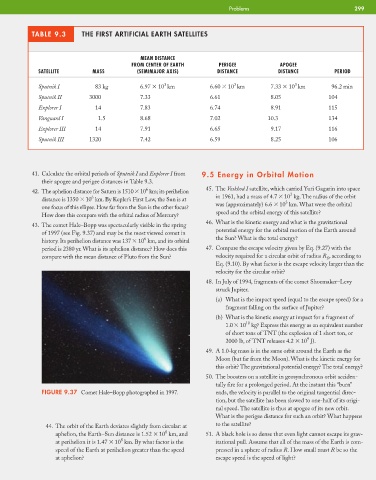
                         FIGURE 9.37 Comet Hale–Bopp photographed in 1997.    ends, the velocity is parallel to the original tangential direc-
                                                                              tion, but the satellite has been slowed to one-half of its origi-
                                                                              nal speed. The satellite is thus at apogee of its new orbit.
                                                                              What is the perigee distance for such an orbit? What happens
                          44. The orbit of the Earth deviates slightly from circular: at  to the satellite?
                                                              8
                             aphelion, the Earth–Sun distance is 1.52   10 km, and  51. A black hole is so dense that even light cannot escape its grav-
                                                 8
                             at perihelion it is 1.47   10 km. By what factor is the  itational pull. Assume that all of the mass of the Earth is com-
                             speed of the Earth at perihelion greater than the speed  pressed in a sphere of radius R. How small must R be so the
                             at aphelion?                                     escape speed is the speed of light?

