


Page 101 - Fisika Terapan for Engineers and Scientists
P. 101
Problems 301
(c) Suppose that a satellite is shot from the gun with a hori- **69. Prove that the orbital energy of a planet or a comet in an ellip-
zontal velocity of 3.00 km/s. Make a rough sketch show- tical orbit around the Sun can be expressed as
ing the Moon and the shape of the satellite’s orbit. Is this
GM m
a closed orbit? S
E
r r 2
1
*62. According to an estimate, a large crater on Wilkes Land,
13
Antarctica, was produced by the impact of a 1.2 10 –kg where r and r are, respectively, the perihelion and aphelion
1
2
meteoroid incident on the surface of the Earth at 70000 km/h. distances. [Hint: Use the conservation of energy and the
What was the speed of this meteoroid relative to the Earth conservation of angular momentum (r v r v ) at perihe-
2 2
1 1
2
2
when it was at a “large” distance from the Earth? lion and at aphelion to solve for v and v in terms of r 1
1
2
and r .]
*63. An experienced baseball player can throw a ball with a speed 2
of 140 km/h. Suppose that an astronaut standing on Mimas, *70. Suppose that a comet is originally at rest at a distance r from
1
19
a small moon of Saturn of mass 3.76 10 kg and radius the Sun. Under the influence of the gravitational pull, the
195 km, throws a ball with this speed. comet falls radially toward the Sun. Show that the time it
takes to reach a radius r is
(a) If the astronaut throws the ball horizontally, will it orbit 2
around Mimas? r 2 dr
t
(b) If the astronaut throws the ball vertically, how high will
S
S
r 1 22GM /r 2GM /r 1
it rise?
*71. Suppose that a projectile is fired horizontally from the surface
*64. An electromagnetic launcher, or rail gun, accelerates a projectile
of the Moon with an initial speed of 2.0 km/s. Roughly sketch
by means of magnetic fields. According to some calculations,
the orbit of the projectile. What maximum height will this
it may be possible to attain muzzle speeds as large as
projectile reach? What will be its speed when it reaches maxi-
15 km/s with such a device. Suppose that a projectile is
mum height?
launched upward from the surface of the Earth with this
8
speed; ignore air resistance. **72. The Earth has an orbit of radius 1.50 10 km around the
8
Sun; Mars has an orbit of radius 2.28 10 km. In order to
(a) Will the projectile escape permanently from the Earth?
send a spacecraft from the Earth to Mars, it is convenient to
(b) Can the projectile escape permanently from the Solar
launch the spacecraft into an elliptical orbit whose perihelion
System? (Hint: Take into account the speed of 30 km/s
coincides with the orbit of the Earth and whose aphelion
of the Earth around the Sun.)
coincides with the orbit of Mars (Fig. 9.38); this orbit requires
*65. Sputnik I, the first Russian satellite (1957), had a mass of the least amount of energy for a trip to Mars.
83.5 kg; its orbit reached perigee at a height of 225 km and
(a) To achieve such an orbit, with what speed (relative to the
apogee at 959 km. Explorer I, the first American satellite
Earth) must the spacecraft be launched? Ignore the pull of
(1958), had a mass of 14.1 kg; its orbit reached perigee at a
the gravity of the Earth and Mars on the spacecraft.
height of 368 km and apogee at 2540 km. What was the
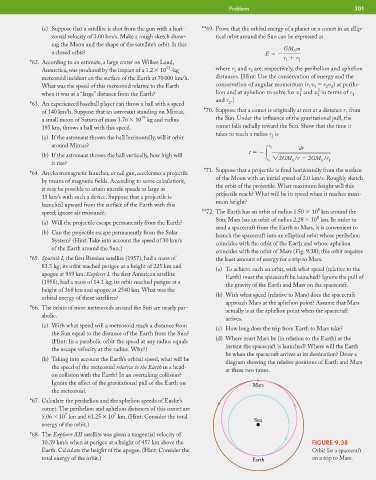
(b) With what speed (relative to Mars) does the spacecraft
orbital energy of these satellites?
approach Mars at the aphelion point? Assume that Mars
*66. The orbits of most meteoroids around the Sun are nearly par-
actually is at the aphelion point when the spacecraft
abolic.
arrives.
(a) With what speed will a meteoroid reach a distance from
(c) How long does the trip from Earth to Mars take?
the Sun equal to the distance of the Earth from the Sun?
(d) Where must Mars be (in relation to the Earth) at the
(Hint: In a parabolic orbit the speed at any radius equals
instant the spacecraft is launched? Where will the Earth
the escape velocity at the radius. Why?)
be when the spacecraft arrives at its destination? Draw a
(b) Taking into account the Earth’s orbital speed, what will be
diagram showing the relative positions of Earth and Mars
the speed of the meteoroid relative to the Earth in a head-
at these two times.
on collision with the Earth? In an overtaking collision?
Ignore the effect of the gravitational pull of the Earth on Mars
the meteoroid.
*67. Calculate the perihelion and the aphelion speeds of Encke’s
comet. The perihelion and aphelion distances of this comet are
7
7
5.06 10 km and 61.25 10 km. (Hint: Consider the total
Sun
energy of the orbit.)
*68. The Explorer XII satellite was given a tangential velocity of
10.39 km/s when at perigee at a height of 457 km above the FIGURE 9.38
Earth. Calculate the height of the apogee. (Hint: Consider the Orbit for a spacecraft
total energy of the orbit.) Earth on a trip to Mars.

