


Page 103 - Fisika Terapan for Engineers and Scientists
P. 103
Answers to Checkups                           303


                                                                              How high will this rocket rise? Neglect any residual atmo-
                                                                              spheric friction.
                                                                          *86. An astronaut in a spacecraft in a circular orbit around the Earth
                                                                              wants to get rid of a defective solar panel that he has detached
                                                                              from the spacecraft. He hits the panel with a blast from the
                                                                              steering rocket of the spacecraft, giving it an increment of veloc-
                                                                              ity.This sends the solar panel into an elliptical orbit.
                                                                              (a) Sketch the circular orbit of the spacecraft and the elliptical
                                                                                 orbit of the solar panel if the velocity increment is parallel
                                                                                 to the velocity of the spacecraft and if it is antiparallel.
                                                                              (b) If the ratio of the semimajor axis of the ellipse to the
                                                                                 radius of the circle has a special value, it is possible for the
                                                                                 panel to meet with the spacecraft again after several orbits.
                                                                                 What are these special values of the ratio?
                                                                          *87. A communications satellite of mass 700 kg is placed in a cir-
                                                                                                   7
                                                                              cular orbit of radius 4.23   10 m around the Earth.
                                                                              (a) What is the total orbital energy of this satellite?
                                                                              (b) How much extra energy would we have to give this satel-
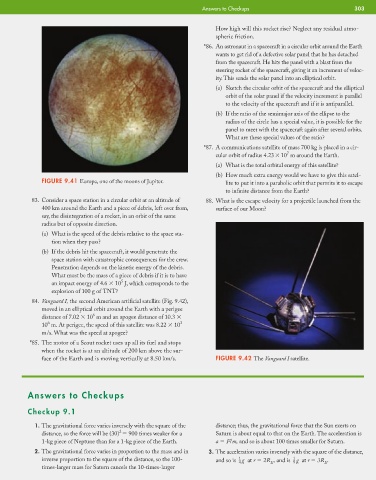
                         FIGURE 9.41 Europa, one of the moons of Jupiter.        lite to put it into a parabolic orbit that permits it to escape
                                                                                 to infinite distance from the Earth?
                      83. Consider a space station in a circular orbit at an altitude of  88. What is the escape velocity for a projectile launched from the
                         400 km around the Earth and a piece of debris, left over from,  surface of our Moon?
                         say, the disintegration of a rocket, in an orbit of the same
                         radius but of opposite direction.
                         (a) What is the speed of the debris relative to the space sta-
                            tion when they pass?
                         (b) If the debris hit the spacecraft, it would penetrate the
                            space station with catastrophic consequences for the crew.
                            Penetration depends on the kinetic energy of the debris.
                            What must be the mass of a piece of debris if it is to have
                                                 5
                            an impact energy of 4.6   10 J, which corresponds to the
                            explosion of 100 g of TNT?
                      84. Vanguard I, the second American artificial satellite (Fig. 9.42),
                         moved in an elliptical orbit around the Earth with a perigee
                                         6
                         distance of 7.02   10 m and an apogee distance of 10.3
                           6
                         10 m. At perigee, the speed of this satellite was 8.22   10 3
                         m/s. What was the speed at apogee?
                     *85. The motor of a Scout rocket uses up all its fuel and stops
                         when the rocket is at an altitude of 200 km above the sur-
                         face of the Earth and is moving vertically at 8.50 km/s.  FIGURE 9.42 The Vanguard I satellite.


                     Answers to Checkups

                     Checkup 9.1

                       1. The gravitational force varies inversely with the square of the  distance; thus, the gravitational force that the Sun exerts on
                                                 2
                         distance, so the force will be (30)   900 times weaker for a   Saturn is about equal to that on the Earth. The acceleration is
                         1-kg piece of Neptune than for a 1-kg piece of the Earth.  a   F/m, and so is about 100 times smaller for Saturn.
                       2. The gravitational force varies in proportion to the mass and in  3. The acceleration varies inversely with the square of the distance,
                                                                                                     1
                                                                                     1
                         inverse proportion to the square of the distance, so the 100-  and so is  g  at r   2R , and is  g  at r   3R .
                                                                                                     9
                                                                                                               E
                                                                                     4
                                                                                              E
                         times-larger mass for Saturn cancels the 10-times-larger

