


Page 108 - Fisika Terapan for Engineers and Scientists
P. 108
308                                CHAPTER 10  Systems of Particles


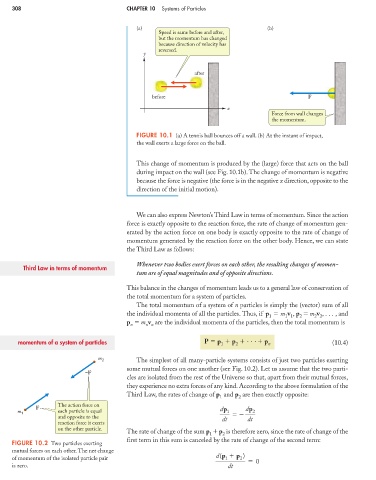
                                                      (a)                                    (b)
                                                            Speed is same before and after,
                                                            but the momentum has changed
                                                            because direction of velocity has
                                                            reversed.
                                                        y


                                                                       after


                                                           before                                         F

                                                                                 x
                                                                                               Force from wall changes
                                                                                               the momentum.

                                                      FIGURE 10.1 (a) A tennis ball bounces off a wall. (b) At the instant of impact,
                                                      the wall exerts a large force on the ball.


                                                      This change of momentum is produced by the (large) force that acts on the ball
                                                      during impact on the wall (see Fig. 10.1b).The change of momentum is negative
                                                      because the force is negative (the force is in the negative x direction, opposite to the
                                                      direction of the initial motion).


                                                      We can also express Newton’s Third Law in terms of momentum. Since the action
                                                   force is exactly opposite to the reaction force, the rate of change of momentum gen-
                                                   erated by the action force on one body is exactly opposite to the rate of change of
                                                   momentum generated by the reaction force on the other body. Hence, we can state
                                                   the Third Law as follows:

                                                      Whenever two bodies exert forces on each other, the resulting changes of momen-
                   Third Law in terms of momentum
                                                      tum are of equal magnitudes and of opposite directions.

                                                   This balance in the changes of momentum leads us to a general law of conservation of
                                                   the total momentum for a system of particles.
                                                      The total momentum of a system of n particles is simply the (vector) sum of all
                                                   the individual momenta of all the particles. Thus, if p   m v , p   m v , ..., and
                                                                                              1    1 1  2   2 2
                                                   p   m v are the individual momenta of the particles, then the total momentum is
                                                    n    n n

                  momentum of a system of particles                       P   p   p       p   n                  (10.4)
                                                                                    2
                                                                               1
                                          m 2         The simplest of all many-particle systems consists of just two particles exerting
                                                   some mutual forces on one another (see Fig. 10.2). Let us assume that the two parti-
                                      –F
                                                   cles are isolated from the rest of the Universe so that, apart from their mutual forces,
                                                   they experience no extra forces of any kind. According to the above formulation of the
                                                   Third Law, the rates of change of p and p are then exactly opposite:
                                                                               1     2
                              The action force on
                       F                                                       dp      dp
                  m 1         each particle is equal                             1       2
                              and opposite to the                               dt       dt
                              reaction force it exerts
                              on the other particle.
                                                   The rate of change of the sum p  p is therefore zero, since the rate of change of the
                                                                            1   2
                                                   first term in this sum is canceled by the rate of change of the second term:
                FIGURE 10.2 Two particles exerting
                mutual forces on each other. The net change
                                                                              d (p   p )
                of momentum of the isolated particle pair                        1    2
                                                                                            0
                is zero.                                                         dt

