


Page 113 - Fisika Terapan for Engineers and Scientists
P. 113
10.2  Center of Mass                           313


                      ✔      Checkup 10.1


                     QUESTION 1: An automobile and a truck have equal momenta. Which has the larger
                     speed? Which has the larger kinetic energy?
                     QUESTION 2: An automobile and a truck are traveling along a street in opposite direc-
                     tions. Can they have the same momentum? The same kinetic energy?
                     QUESTION 3: A rubber ball, dropped on a concrete floor, bounces up with reversed
                     velocity. Is the momentum before the impact the same as after the impact?
                     QUESTION 4: Is the net momentum of the Sun and all the planets and moons of the
                     Solar System constant? Is the net kinetic energy constant?
                     QUESTION 5: Consider two automobiles of equal masses m and equal speeds v. (a) If
                     both automobiles are moving southward on a street, what are the total kinetic energy
                     and the total momentum of this system of two automobiles? (b) If one automobile is
                     moving southward and one northward? (c) If one automobile is moving southward
                     and one eastward?
                     QUESTION 6: An automobile and a truck have equal kinetic energies. Which has the
                     larger speed? Which has the larger momentum? Assume that the truck has the larger
                     mass.
                        (A) Truck; truck           (B) Truck; automobile
                        (C) Automobile; truck       (D) Automobile; automobile


                     10.2 CENTER OF MASS


                     In our study of kinematics and dynamics in the preceding chapters we always ignored
                     the size of the bodies; even when analyzing the motion of a large body—an automo-
                     bile or a ship—we pretended that the motion could be treated as particle motion, posi-
                     tion being described by means of some reference point marked on the body. In reality,
                     large bodies are systems of particles, and their motion obeys Eq. (10.13) for a system
                     of particles. This equation can be converted into an equation of motion containing
                     just one acceleration rather than the rate of change of momentum of the entire system,
                     by taking as reference point the center of mass of the body.The equation that describes  center of mass
                     the motion of this special point has the same mathematical form as the equation of
                     motion of a particle; that is, the motion of the center of mass mimics particle motion
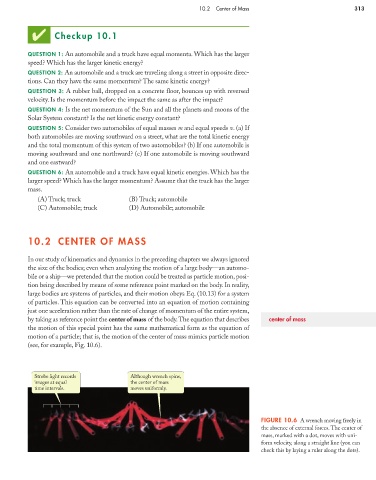
                     (see, for example, Fig. 10.6).


                       Strobe light records         Although wrench spins,
                       images at equal              the center of mass
                       time intervals.              moves uniformly.


                                                                                            FIGURE 10.6 A wrench moving freely in
                                                                                            the absence of external forces. The center of
                                                                                            mass, marked with a dot, moves with uni-
                                                                                            form velocity, along a straight line (you can
                                                                                            check this by laying a ruler along the dots).

