


Page 112 - Fisika Terapan for Engineers and Scientists
P. 112
312                                CHAPTER 10  Systems of Particles


                                                   Likewise
                                                                            dp 2
                                                                                  F     F                        (10.9)
                                                                             dt    2,int  2,ext

                                                   If we add the left sides of these equations and the right sides, the contributions from
                                                   the internal forces cancel (that is, F    F    0), since they are action–reaction
                                                                                1,int  2,int
                                                   pairs. What remains is
                                                                         dp    dp
                                                                           1     2
                                                                                     F 1,ext    F 2,ext         (10.10)
                                                                          dt    dt
                                                      The sum of the rates of change of the momenta is the same as the rate of change
                                                   of the sum of the momenta; hence,
                                                                         d(p   p )
                                                                            1
                                                                                 2
                                                                                     F 1,ext    F 2,ext         (10.11)
                                                                             dt
                                                      The sum P   p  p is the total momentum, and the sum F   F   is the
                                                                   1   2                                1,ext  2,ext
                              For any number of    total external force on the particle system. Thus, Eq. (10.11) states that the rate of
                              particles, the mutual
                              forces of each pair are  change of the total momentum of the two-particle system equals the total external
                     m 1      equal and opposite.  force.
                                                      For a system containing more than two particles, we can obtain similar results. If
                                                   the system is isolated so that there are no external forces, then the mutual interparti-
                                        m 3
                                                   cle forces acting between pairs of particles merely transfer momentum from one par-
                                                   ticle of the pair to the other, just as in the case of two particles. Since all the internal
                                                   forces necessarily arise from such forces between pairs of particles, these internal forces
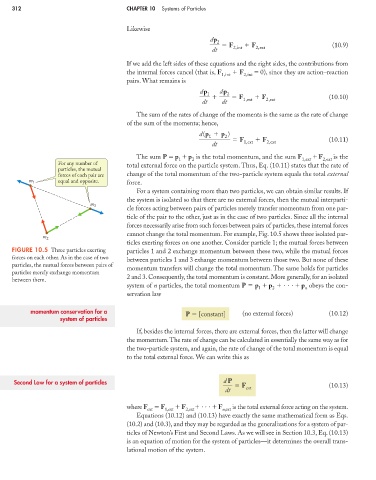
                                                   cannot change the total momentum. For example, Fig. 10.5 shows three isolated par-
                         m 2
                                                   ticles exerting forces on one another. Consider particle 1; the mutual forces between
                FIGURE 10.5 Three particles exerting  particles 1 and 2 exchange momentum between these two, while the mutual forces
                forces on each other. As in the case of two  between particles 1 and 3 exhange momentum between those two. But none of these
                particles, the mutual forces between pairs of
                                                   momentum transfers will change the total momentum. The same holds for particles
                particles merely exchange momentum
                                                   2 and 3. Consequently, the total momentum is constant. More generally, for an isolated
                between them.
                                                   system of n particles, the total momentum P   p   p           p obeys the con-
                                                                                           1   2         n
                                                   servation law
                      momentum conservation for a                    P   [constant]   (no external forces)      (10.12)
                               system of particles

                                                      If, besides the internal forces, there are external forces, then the latter will change
                                                   the momentum.The rate of change can be calculated in essentially the same way as for
                                                   the two-particle system, and again, the rate of change of the total momentum is equal
                                                   to the total external force. We can write this as


                 Second Law for a system of particles                           d P    F                        (10.13)
                                                                                 dt    ext

                                                   where F   F     F        F      is the total external force acting on the system.
                                                         ext  1,ext  2,ext      n,ext
                                                      Equations (10.12) and (10.13) have exactly the same mathematical form as Eqs.
                                                   (10.2) and (10.3), and they may be regarded as the generalizations for a system of par-
                                                   ticles of Newton’s First and Second Laws. As we will see in Section 10.3, Eq. (10.13)
                                                   is an equation of motion for the system of particles—it determines the overall trans-
                                                   lational motion of the system.

