


Page 203 - Fisika Terapan for Engineers and Scientists
P. 203
13.2  The Equation of Rotational Motion                     403


                                                                  2
                        COMMENT: If the mass of the pulley is small, then I	R can be neglected; with this
                        approximation, Eq. (13.24) reduces to Eq. (5.44), which was obtained without
                        taking into account the inertia of the pulley.
                           A device of this kind, called Atwood’s machine, can be used to determine the  Atwood’s machine
                        value of g. For this purpose, it is best to use masses m andm that are nearly equal.
                                                                 1
                                                                       2
                        Then a is much smaller than g and easier to measure; the value of g can be calcu-
                        lated from the measured value of a according to Eq. (13.24).


                        In some cases—for instance, the rolling motion of a wheel—the axis of rota-
                     tion is in motion, perhaps accelerated motion, and is not a fixed axis. For such
                     problems, some further arguments can be used to demonstrate that Eq. (13.19)
                     remains valid for rotation about an axis in accelerated translational motion, provided
                     the axis passes through the center of mass of the rotating body. When this condition is
                     met, we can use the equation of rotational motion (13.19) as in the following
                     examples.


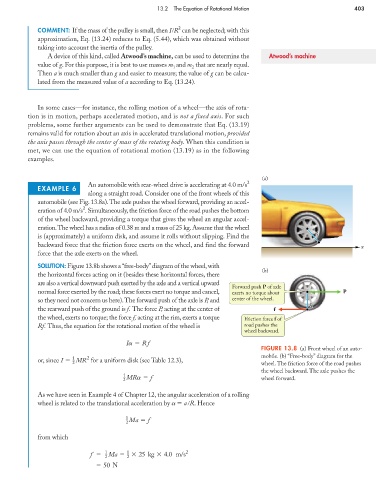
                                                                                            (a)
                                       An automobile with rear-wheel drive is accelerating at 4.0 m/s 2
                        EXAMPLE 6
                                       along a straight road. Consider one of the front wheels of this
                        automobile (see Fig. 13.8a).The axle pushes the wheel forward, providing an accel-
                                     2
                        eration of 4.0 m/s . Simultaneously, the friction force of the road pushes the bottom
                        of the wheel backward, providing a torque that gives the wheel an angular accel-
                        eration.The wheel has a radius of 0.38 m and a mass of 25 kg. Assume that the wheel
                        is (approximately) a uniform disk, and assume it rolls without slipping. Find the   R R
                        backward force that the friction force exerts on the wheel, and find the forward                  x
                        force that the axle exerts on the wheel.
                        SOLUTION: Figure 13.8b shows a “free-body” diagram of the wheel, with
                                                                                            (b)
                        the horizontal forces acting on it (besides these horizontal forces, there
                        are also a vertical downward push exerted by the axle and a vertical upward
                                                                                   Forward push P of axle
                        normal force exerted by the road; these forces exert no torque and cancel,  exerts no torque about  P
                        so they need not concern us here).The forward push of the axle is P, and  center of the wheel.
                                                                                                          R R
                        the rearward push of the ground is f. The force P, acting at the center of  f
                        the wheel, exerts no torque; the force f, acting at the rim, exerts a torque  Friction force f of
                        Rf. Thus, the equation for the rotational motion of the wheel is  road pushes the
                                                                                       wheel backward.
                                                   I    Rf
                                                                                            FIGURE 13.8 (a) Front wheel of an auto-
                                                                                            mobile. (b) “Free-body” diagram for the
                                  1    2
                        or, since I   MR  for a uniform disk (see Table 12.3),              wheel. The friction force of the road pushes
                                  2
                                                                                            the wheel backward. The axle pushes the
                                                  1
                                                  2 MR    f                                 wheel forward.
                        As we have seen in Example 4 of Chapter 12, the angular acceleration of a rolling
                        wheel is related to the translational acceleration by     a 	R. Hence

                                                   1
                                                   2 Ma   f

                        from which

                                            1
                                                   1
                                          f      Ma     25 kg   4.0 m/s 2
                                                   2
                                            2
                                            50 N

