


Page 202 - Fisika Terapan for Engineers and Scientists
P. 202
402 CHAPTER 13 Dynamics of a Rigid Body
Pulley is mounted Support force
to a fixed support. acts at center,
thus producing
no torque.
R
P' P
T 1
T 2
String rotates
pulley without (b) T and T need
1
2
slipping. to be different to
produce an angular
acceleration of
(massive) pulley.
x T 2
m 2
T 1
w
m 1 2
(a)
w 1
(c)
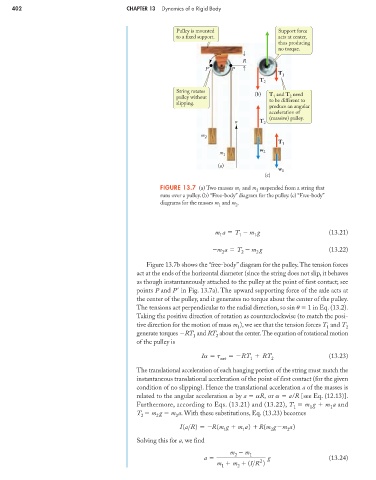
FIGURE 13.7 (a) Two masses m and m suspended from a string that
2
1
runs over a pulley. (b) “Free-body” diagram for the pulley. (c) “Free-body”
diagrams for the masses m and m .
2
1
m a T m g (13.21)
1 1 1
m a T m g (13.22)
2 2 2
Figure 13.7b shows the “free-body” diagram for the pulley.The tension forces
act at the ends of the horizontal diameter (since the string does not slip, it behaves
as though instantaneously attached to the pulley at the point of first contact; see
points P and P in Fig. 13.7a). The upward supporting force of the axle acts at
the center of the pulley, and it generates no torque about the center of the pulley.
The tensions act perpendicular to the radial direction, so sin 1 in Eq. (13.2).
Taking the positive direction of rotation as counterclockwise (to match the posi-
tive direction for the motion of mass m ), we see that the tension forces T and T 2
1
1
generate torques RT and RT about the center.The equation of rotational motion
2
1
of the pulley is
I t RT RT (13.23)
net 1 2
The translational acceleration of each hanging portion of the string must match the
instantaneous translational acceleration of the point of first contact (for the given
condition of no slipping). Hence the translational acceleration a of the masses is
related to the angular acceleration by a R, or a/R [see Eq. (12.13)].
Furthermore, according to Eqs. (13.21) and (13.22), T m g m a and
1
1
1
T m g m a. With these substitutions, Eq. (13.23) becomes
2
2
2
I(a>R) R(m g m a) R(m g m a)
1
1
2
2
Solving this for a, we find
m m 1
2
a 2 g (13.24)
m m (I>R )
1 2

