


Page 199 - Fisika Terapan for Engineers and Scientists
P. 199
13.2  The Equation of Rotational Motion                     399


                      ✔      Checkup 13.1


                     QUESTION 1: You are trying to tighten a bolt with a wrench. Where along the handle
                     should you place your hand so you can exert maximum torque? In what direction
                     should you push?
                     QUESTION 2: A force is being exerted against the rim of a freely rotating wheel, but
                     the work done by this force is zero. What can you conclude about the direction of the
                     force? What is the torque of the force?
                     QUESTION 3: Consider the meterstick falling over, as in Example 2.What is the torque
                     that the weight exerts on the meterstick when it is in the upright, initial position?
                     After the stick begins to fall over, the torque increases. When is the torque maximum?
                     QUESTION 4: Suppose you first push a door at its outer edge at right angles to the sur-
                     face of the door with a force of magnitude F. Next you push the door at its center,
                     again at right angles to the surface, with a force of magnitude F 2. In both cases you
                     push the door as it moves through 30 .The ratio of the work done by the second push
                     to the work done by the first push is:
                        (A)   1     (B)   1      (C) 1        (D) 2         (E) 4
                           4            2


                     13.2 THE EQUATION OF
                     ROTATIONAL MOTION


                     Our intuition tells us that a torque acting on a wheel or some other body free to rotate
                     about an axis will produce an angular acceleration. For instance, the push of your hand
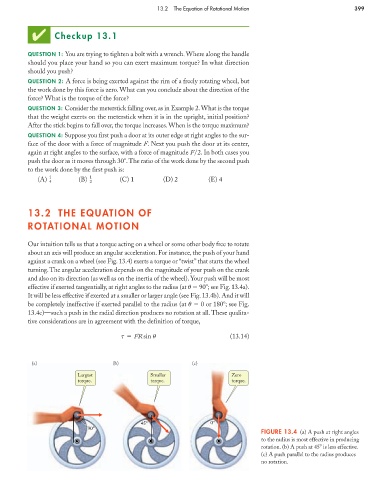
                     against a crank on a wheel (see Fig. 13.4) exerts a torque or “twist” that starts the wheel
                     turning.The angular acceleration depends on the magnitude of your push on the crank
                     and also on its direction (as well as on the inertia of the wheel). Your push will be most
                     effective if exerted tangentially, at right angles to the radius (at     90 ; see Fig. 13.4a).
                     It will be less effective if exerted at a smaller or larger angle (see Fig. 13.4b). And it will
                     be completely ineffective if exerted parallel to the radius (at     0 or 180 ; see Fig.
                     13.4c)—such a push in the radial direction produces no rotation at all.These qualita-
                     tive considerations are in agreement with the definition of torque,

                                                 t   FR sin u                     (13.14)


                      (a)                      (b)                     (c)
                                    Largest               Smaller                  Zero
                                    torque.               torque.                  torque.


                                                       45°                  0°
                                       90°
                                                                                            FIGURE 13.4 (a) A push at right angles
                                                                                            to the radius is most effective in producing
                                                                                            rotation. (b) A push at 45  is less effective.
                                                                                            (c) A push parallel to the radius produces
                                                                                            no rotation.

