


Page 201 - Fisika Terapan for Engineers and Scientists
P. 201
13.2  The Equation of Rotational Motion                     401


                                       The rotor of the gyroscope of the Gravity Probe B experiment
                        EXAMPLE 4                                                          Concepts
                                       (see the chapter photo and Fig. 13.6) is a quartz sphere of  in
                        diameter 3.8 cm and mass 7.61   10  2  kg.To start this sphere spinning, a stream  Context
                        of helium gas flowing in an equatorial channel in the surface of the housing is
                        blown tangentially against the rotor. What torque must this stream of gas exert on
                        the rotor to accelerate it uniformly from 0 to 10000 rpm (revolutions per minute)
                        in 30 minutes? What force must it exert on the equator of the sphere?
                        SOLUTION: The final angular velocity is 2    10000 radians 60 s   1.05   10 3
                        radians/s, and therefore the angular acceleration is

                                   2
                                        1

                                  t   t
                                   2     1
                                          3
                                  1.05   10 radians/s   0             2
                                                         0.582 radian/s
                                      30   60 s   0
                        The moment of inertia of the rotor is that of a sphere (see Table 12.3):
                                 2
                               I   MR 2
                                 5
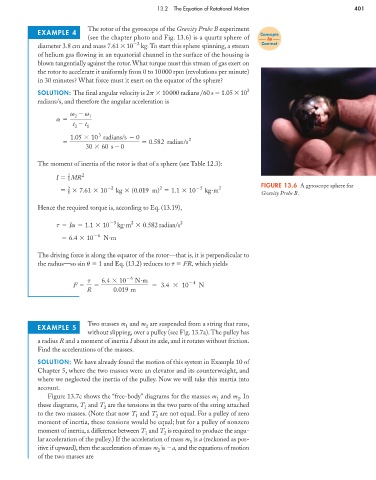
                                                                                            FIGURE 13.6 A gyroscope sphere for
                                 2
                                                             2
                                              2
                                                                               2
                                                                         5
                                   7.61   10   kg   (0.019  m)   1.1   10  kg m             Gravity Probe B.
                                 5
                        Hence the required torque is, according to Eq. (13.19),
                                               5    2              2
                               t   I    1.1   10  kg m   0.582 radian/s
                                 6.4   10  6    N m
                        The driving force is along the equator of the rotor—that is, it is perpendicular to
                        the radius—so sin     1 and Eq. (13.2) reduces to     FR, which yields

                                       t   6.4   10  6   N m           4
                                   F                          3.4     10  N
                                       R       0.019 m


                                       Two masses m and m are suspended from a string that runs,
                        EXAMPLE 5                 1      2
                                       without slipping, over a pulley (see Fig. 13.7a).The pulley has
                        a radius R and a moment of inertia I about its axle, and it rotates without friction.
                        Find the accelerations of the masses.

                        SOLUTION: We have already found the motion of this system in Example 10 of
                        Chapter 5, where the two masses were an elevator and its counterweight, and
                        where we neglected the inertia of the pulley. Now we will take this inertia into
                        account.
                           Figure 13.7c shows the “free-body” diagrams for the masses m and m .In
                                                                              1     2
                        these diagrams, T and T are the tensions in the two parts of the string attached
                                      1     2
                        to the two masses. (Note that now T and T are not equal. For a pulley of zero
                                                     1      2
                        moment of inertia, these tensions would be equal; but for a pulley of nonzero
                        moment of inertia, a difference between T and T is required to produce the angu-
                                                        1     2
                        lar acceleration of the pulley.) If the acceleration of mass m is a (reckoned as pos-
                                                                      1
                        itive if upward), then the acceleration of mass m is  a, and the equations of motion
                                                            2
                        of the two masses are

