


Page 227 - Fisika Terapan for Engineers and Scientists
P. 227
Review Problems                            427


                      *97. A hoop of mass M and radius R rolls down a sloping ramp
                          that makes an angle of 30  with the ground. What is the
                                                                                                   l/4
                          acceleration of the hoop if it rolls without slipping?
                      *98. An automobile has the arrangement of the wheels shown in                    l
                          Fig. 13.41. The mass of this automobile is 1800 kg, the
                          center of mass is at the midpoint of the rectangle formed by
                          the wheels, and the moment of inertia about a vertical axis
                                                        2
                          through the center of mass is 2200 kg m . Suppose that
                                                                                FIGURE 13.42 A ball of putty strikes a rod.
                          during braking in an emergency, the left front and rear
                          wheels lock and begin to skid while the right wheels con-
                          tinue to rotate just short of skidding. The coefficient of  (c) What is the angular momentum about this center of
                          static friction between the wheels and the road is     0.90,  mass? What is the moment of inertia, and what is the
                                                               s
                          and the coefficient of kinetic friction is     0.50. Calculate  angular velocity?
                                                       k
                          the instantaneous angular acceleration of the automobile  *101. A communications satellite of mass 1000 kg is in a circular
                          about the vertical axis through the center of mass.  orbit of radius 4.22   10 m around the Earth. The orbit is
                                                                                                 7
                                                                               in the equatorial plane of the Earth, and the satellite moves
                                          3.0 m
                                                                               along it from west to east. What are the magnitude and the
                                                                               direction of the angular-momentum vector of this satellite?
                                                                          *102. The spin angular momentum of the Earth has a magnitude
                                                       1.5 m                           33    2
                                                                               of 5.9   10 kg m /s. Because of forces exerted by the Sun
                                                                               and the Moon, the spin angular momentum gradually
                                                                               changes direction, describing a cone of half-angle 23.5  (Fig.
                                FIGURE 13.41 An automobile.                    13.43). The angular-momentum vector takes 26000 years to
                                                                               swing once around this cone. What is the magnitude of the
                                                                               rate of change of the angular-momentum vector; that is,
                      *99. Neutron stars, or pulsars, spin very quickly about their axes.
                                                                               what is the value of |dL dt|?
                          Their high rate of spin is the result of the conservation of
                          angular momentum during the formation of the neutron star
                          by the gradual contraction (shrinking) of an initially normal
                          star.
                          (a) Suppose that the initial star is similar to the Sun, with a
                                          8
                             radius of 7.0   10 m and a rate of rotation of 1.0 revo-
                             lution per month. If this star contracts to a radius of
                                   4
                             1.0   10 m, by what factor does the moment of inertia                    23.5°
                             increase? Assume that the relative distribution of mass
                             in the initial and the final stars is roughly the same.
                          (b) By what factor does the angular velocity increase? What
                             is the final angular velocity?
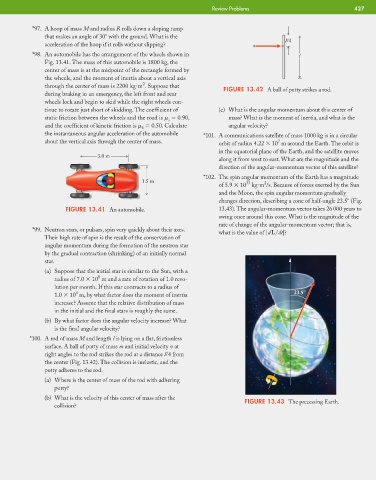
                     *100. A rod of mass M and length l is lying on a flat, frictionless
                          surface. A ball of putty of mass m and initial velocity v at
                          right angles to the rod strikes the rod at a distance l/4 from
                          the center (Fig. 13.42). The collision is inelastic, and the
                          putty adheres to the rod.
                          (a) Where is the center of mass of the rod with adhering
                             putty?
                          (b) What is the velocity of this center of mass after the
                                                                                       FIGURE 13.43 The precessing Earth.
                             collision?

