


Page 232 - Fisika Terapan for Engineers and Scientists
P. 232
432                                CHAPTER 14  Statics and Elasticity


                (a) stable equilibrium               (b) unstable equilibrium             (c) neutral equilibrium
                 string
                             Chair is suspended
                             from a point above
                             center of mass.


                                                                                                         Chair is supported
                                                                                                         at center of mass.

                                                                    Chair is supported
                                                                    from a point below
                                                                    center of mass.


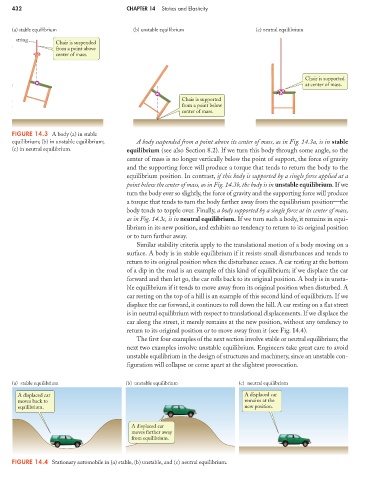
                FIGURE 14.3 A body (a) in stable
                equilibrium; (b) in unstable equilibrium;  A body suspended from a point above its center of mass, as in Fig. 14.3a, is in stable
                (c) in neutral equilibrium.        equilibrium (see also Section 8.2). If we turn this body through some angle, so the
                                                   center of mass is no longer vertically below the point of support, the force of gravity
                                                   and the supporting force will produce a torque that tends to return the body to the
                                                   equilibrium position. In contrast, if this body is supported by a single force applied at a
                                                   point below the center of mass, as in Fig. 14.3b, the body is in unstable equilibrium. If we
                                                   turn the body ever so slightly, the force of gravity and the supporting force will produce
                                                   a torque that tends to turn the body farther away from the equilibrium position—the
                                                   body tends to topple over. Finally, a body supported by a single force at its center of mass,
                                                   as in Fig. 14.3c, is in neutral equilibrium. If we turn such a body, it remains in equi-
                                                   librium in its new position, and exhibits no tendency to return to its original position
                                                   or to turn farther away.
                                                      Similar stability criteria apply to the translational motion of a body moving on a
                                                   surface. A body is in stable equilibrium if it resists small disturbances and tends to
                                                   return to its original position when the disturbance ceases. A car resting at the bottom
                                                   of a dip in the road is an example of this kind of equilibrium; if we displace the car
                                                   forward and then let go, the car rolls back to its original position. A body is in unsta-
                                                   ble equilibrium if it tends to move away from its original position when disturbed. A
                                                   car resting on the top of a hill is an example of this second kind of equilibrium. If we
                                                   displace the car forward, it continues to roll down the hill. A car resting on a flat street
                                                   is in neutral equilibrium with respect to translational displacements. If we displace the
                                                   car along the street, it merely remains at the new position, without any tendency to
                                                   return to its original position or to move away from it (see Fig. 14.4).
                                                      The first four examples of the next section involve stable or neutral equilibrium; the
                                                   next two examples involve unstable equilibrium. Engineers take great care to avoid
                                                   unstable equilibrium in the design of structures and machinery, since an unstable con-
                                                   figuration will collapse or come apart at the slightest provocation.


                (a) stable equilibrium             (b) unstable equilibrium          (c) neutral equilibrium
                  A displaced car                                                      A displaced car
                  moves back to                                                        remains at the
                  equilibrium.                                                         new position.


                                                    A displaced car
                                                    moves farther away
                                                    from equilibrium.


                FIGURE 14.4 Stationary automobile in (a) stable, (b) unstable, and (c) neutral equilibrium.

