


Page 231 - Fisika Terapan for Engineers and Scientists
P. 231
14.1  Statics of Rigid Bodies                       431


                        From this discussion, we conclude that for the purposes of static equilibrium,
                     any line through the body or any line passing at some distance from the body can be thought
                     of as a conceivable axis of rotation, and the torque about every such axis must be zero.This
                     means we have complete freedom in the choice of the axis of rotation, and we can make
                     whatever choice seems convenient. With some practice, one learns to recognize which
                     choice of axis will be most useful for the solution of a problem in statics.
                        The force of gravity plays an important role in many problems of statics.The force
                     of gravity on a body is distributed over all parts of the body, each part being subjected
                     to a force proportional to its mass. However, for the calculation of the torque exerted
                     by gravity on a rigid body, the entire gravitational force may be regarded as acting on the
                     center of mass.We relied on this rule in Fig. 14.1, where we assumed that the weight acts
                     at the center of mass of the bat.The proof of this rule is easy: Suppose that we release
                     some arbitrary rigid body and permit it to fall freely from an initial condition of rest.
                     Since all the particles in the body fall at the same rate, the body will not change its
                     orientation as it falls. If we consider an axis through the center of mass, the absence of
                     angular acceleration implies that gravity does not generate any torque about the center
                     of mass. Hence, if we want to simulate gravity by a single force acting at one point of
                     the rigid body, that point will have to be the center of mass.
                        Given that in a rigid body the force of gravity effectively acts on the center of
                     mass, we see that a rigid body supported by a single force acting at its center of mass
                     or acting on the vertical line through its center of mass is in equilibrium, since the
                     support force is then collinear with the effective force of gravity, and such collinear
                     forces of equal magnitudes and opposite directions exert no net torque. This pro-
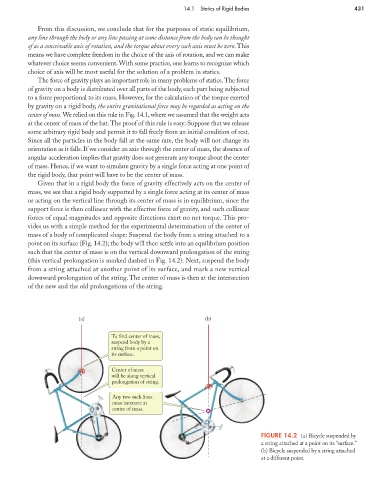
                     vides us with a simple method for the experimental determination of the center of
                     mass of a body of complicated shape: Suspend the body from a string attached to a
                     point on its surface (Fig. 14.2); the body will then settle into an equilibrium position
                     such that the center of mass is on the vertical downward prolongation of the string
                     (this vertical prolongation is marked dashed in Fig. 14.2). Next, suspend the body
                     from a string attached at another point of its surface, and mark a new vertical
                     downward prolongation of the string. The center of mass is then at the intersection
                     of the new and the old prolongations of the string.


                                    (a)                                    (b)


                                              To find center of mass,
                                              suspend body by a
                                              string from a point on
                                              its surface.

                                              Center of mass
                                              will be along vertical
                                              prolongation of string.

                                              Any two such lines
                                              must intersect at
                                              center of mass.


                                                                                            FIGURE 14.2 (a) Bicycle suspended by
                                                                                            a string attached at a point on its “surface.”
                                                                                            (b) Bicycle suspended by a string attached
                                                                                            at a different point.

