


Page 230 - Fisika Terapan for Engineers and Scientists
P. 230
430                                CHAPTER 14  Statics and Elasticity


                                                   ? What is the tension in the tie-rod (stretched diagonally from the top of the tower
                                                     to the end of the arm) that holds the short arm in place? (Example 3, page 435)
                                                   ? What is the elongation of the lifting cable when subjected to a given load?
                                                     (Example 8, page 448)
                                                     ngineers and architects concerned with the design of bridges, buildings, and other
                                                   Estructures need to know under what conditions a body will remain at rest, even
                                                   when forces act on it. For instance, the designer of a railroad bridge must make sure that
                  (a)
                                                   the bridge will not tip over or break when a heavy train passes over it. A body that
                   We can choose an axis           remains at rest, even though several forces act on it, is said to be in equilibrium.The branch
                   through center of mass,
                   out of plane of page.           of physics that studies the conditions for the equilibrium of a body is called statics.
                                                   Statics is the oldest branch of physics.The ancient Egyptians, Greeks, and Romans had
                                                   a good grasp of the basic principles of statics, as is evident from their construction of
                                       N 2         elegant arches for doorways and bridges. The oldest surviving physics textbook is a
                    N 1
                                                   treatise on the statics of ships by Archimedes.
                                                      In the first three sections of this chapter, we will rely on the assumption that the
                                                   “rigid” structural members—such as beams and columns—indeed remain rigid; that is,
                                                   they do not deform. In essence, this means that we assume that the forces are not so
                                                   large as to produce a significant bending or compression of the beams or columns.
                                                   However, in the last section, we will take a brief look at the phenomenon of the elas-
                           r 1       r 2           tic deformation of solid bodies when subjected to the action of large forces.

                                   w
                        Bat is at rest, so torques about
                        that axis must sum to zero:   14.1 STATICS OF RIGID BODIES
                        r N – r N = 0.
                         2 2
                             1 1
                  (b)        We can choose an axis  If a rigid body is to remain at rest, its translational and rotational accelerations must
                             through left hand, out of   be zero. Hence, the condition for the static equilibrium of a rigid body is that the sum
                             plane of page.        of external forces and the sum of external torques on the body must be zero.This means that
                                                   the forces and the torques are in balance; each force is compensated by some other
                                                   force or forces, and each torque is compensated by some other torque or torques. For
                                       N 2
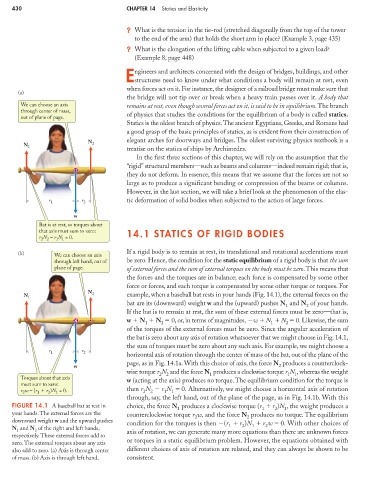
                    N 1                            example, when a baseball bat rests in your hands (Fig. 14.1), the external forces on the
                                                   bat are its (downward) weight w and the (upward) pushes N and N of your hands.
                                                                                                   1     2
                                                   If the bat is to remain at rest, the sum of these external forces must be zero—that is,
                                                   w   N   N   0, or, in terms of magnitudes,  w   N   N   0. Likewise, the sum
                                                        1    2                                1    2
                                                   of the torques of the external forces must be zero. Since the angular acceleration of
                                                   the bat is zero about any axis of rotation whatsoever that we might choose in Fig. 14.1,
                                                   the sum of torques must be zero about any such axis. For example, we might choose a
                           r 1       r 2
                                                   horizontal axis of rotation through the center of mass of the bat, out of the plane of the
                                                   page, as in Fig. 14.1a. With this choice of axis, the force N produces a counterclock-
                                   w                                                             2
                                                   wise torque r N and the force N produces a clockwise torque r N , whereas the weight
                                                                                                    1
                                                                            1
                                                                                                      1
                                                               2
                                                             2
                   Torques about that axis         w (acting at the axis) produces no torque.The equilibrium condition for the torque is
                   must sum to zero:
                   r w – (r   r )N = 0.            then r N   r N   0. Alternatively, we might choose a horizontal axis of rotation
                                                                1
                                                              1
                                                        2
                             1
                        1
                                                          2
                           2
                   2
                                                   through, say, the left hand, out of the plane of the page, as in Fig. 14.1b. With this
                FIGURE 14.1 A baseball bat at rest in  choice, the force N produces a clockwise torque (r   r )N , the weight produces a
                                                                  1                         1   2  1
                your hands. The external forces are the  counterclockwise torque r w, and the force N produces no torque. The equilibrium
                                                                       2
                                                                                       2
                downward weight w and the upward pushes
                                                   condition for the torques is then  (r   r )N   r w   0. With other choices of
                                                                                      2
                                                                                  1
                                                                                             2
                                                                                         1
                N and N of the right and left hands,
                 1
                       2
                respectively. These external forces add to  axis of rotation, we can generate many more equations than there are unknown forces
                                                   or torques in a static equilibrium problem. However, the equations obtained with
                zero. The external torques about any axis
                also add to zero. (a) Axis is through center  different choices of axis of rotation are related, and they can always be shown to be
                of mass. (b) Axis is through left hand.  consistent.

