


Page 258 - Fisika Terapan for Engineers and Scientists
P. 258
458                                CHAPTER 14  Statics and Elasticity


                **48. A power brake invented by Lord Kelvin consists of a strong       humerus
                     flexible belt wrapped once around a spinning flywheel  (a)
                     (Fig. 14.55). One end of the belt is fixed to an overhead sup-
                     port; the other end carries a weight w. The coefficient of
                                                                                       biceps
                     kinetic friction between the belt and the wheel is   . The
                                                         k
                    radius of the wheel is R, and its angular velocity is  .
                     (a) Show that the tension in the belt is
                                             m k
                                      T   we
                       as a function of the angle of contact (Fig. 14.55).
                     (b) Show that the net frictional torque the belt exerts on the  ulna  radius
                       flywheel is
                                                                            (b)
                                   t   wR (1   e  2pm k )

                     (c) Show that the power dissipated by friction is

                                  P   wR  (1   e  2pm k )
                                                                                                        w


                                                                              5.5 cm       30 cm
                                               R                            FIGURE 14.56 Forearm as lever.


                                                                                           25 cm


                                             w
                                                                                                 2500 N
                            FIGURE 14.55 Belt and flywheel.


                14.3 Levers and Pulleys                                                    4.0 cm
                                                                                  FIGURE 14.57 Manual winch.
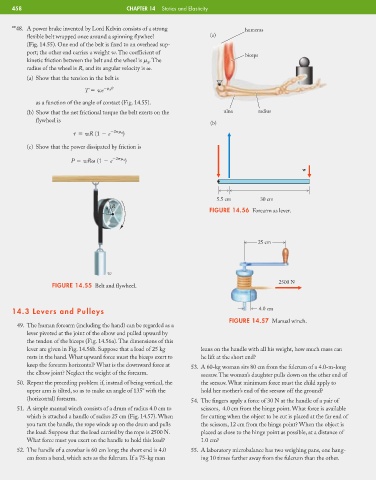
                 49. The human forearm (including the hand) can be regarded as a
                     lever pivoted at the joint of the elbow and pulled upward by
                     the tendon of the biceps (Fig. 14.56a). The dimensions of this
                     lever are given in Fig. 14.56b. Suppose that a load of 25 kg  leans on the handle with all his weight, how much mass can
                     rests in the hand. What upward force must the biceps exert to  he lift at the short end?
                     keep the forearm horizontal? What is the downward force at  53. A 60-kg woman sits 80 cm from the fulcrum of a 4.0-m-long
                     the elbow joint? Neglect the weight of the forearm.  seesaw. The woman’s daughter pulls down on the other end of
                 50. Repeat the preceding problem if, instead of being vertical, the  the seesaw. What minimum force must the child apply to
                     upper arm is tilted, so as to make an angle of 135  with the  hold her mother’s end of the seesaw off the ground?
                     (horizontal) forearm.                            54. The fingers apply a force of 30 N at the handle of a pair of
                  51. A simple manual winch consists of a drum of radius 4.0 cm to  scissors, 4.0 cm from the hinge point. What force is available
                     which is attached a handle of radius 25 cm (Fig. 14.57). When  for cutting when the object to be cut is placed at the far end of
                     you turn the handle, the rope winds up on the drum and pulls  the scissors, 12 cm from the hinge point? When the object is
                     the load. Suppose that the load carried by the rope is 2500 N.  placed as close to the hinge point as possible, at a distance of
                     What force must you exert on the handle to hold this load?  1.0 cm?
                  52. The handle of a crowbar is 60 cm long; the short end is 4.0  55. A laboratory microbalance has two weighing pans, one hang-
                     cm from a bend, which acts as the fulcrum. If a 75-kg man  ing 10 times farther away from the fulcrum than the other.

